
Bucket Elevator vs Belt Conveyor: Best Choice for Vertical Bulk Material Handling

Vijay Baid
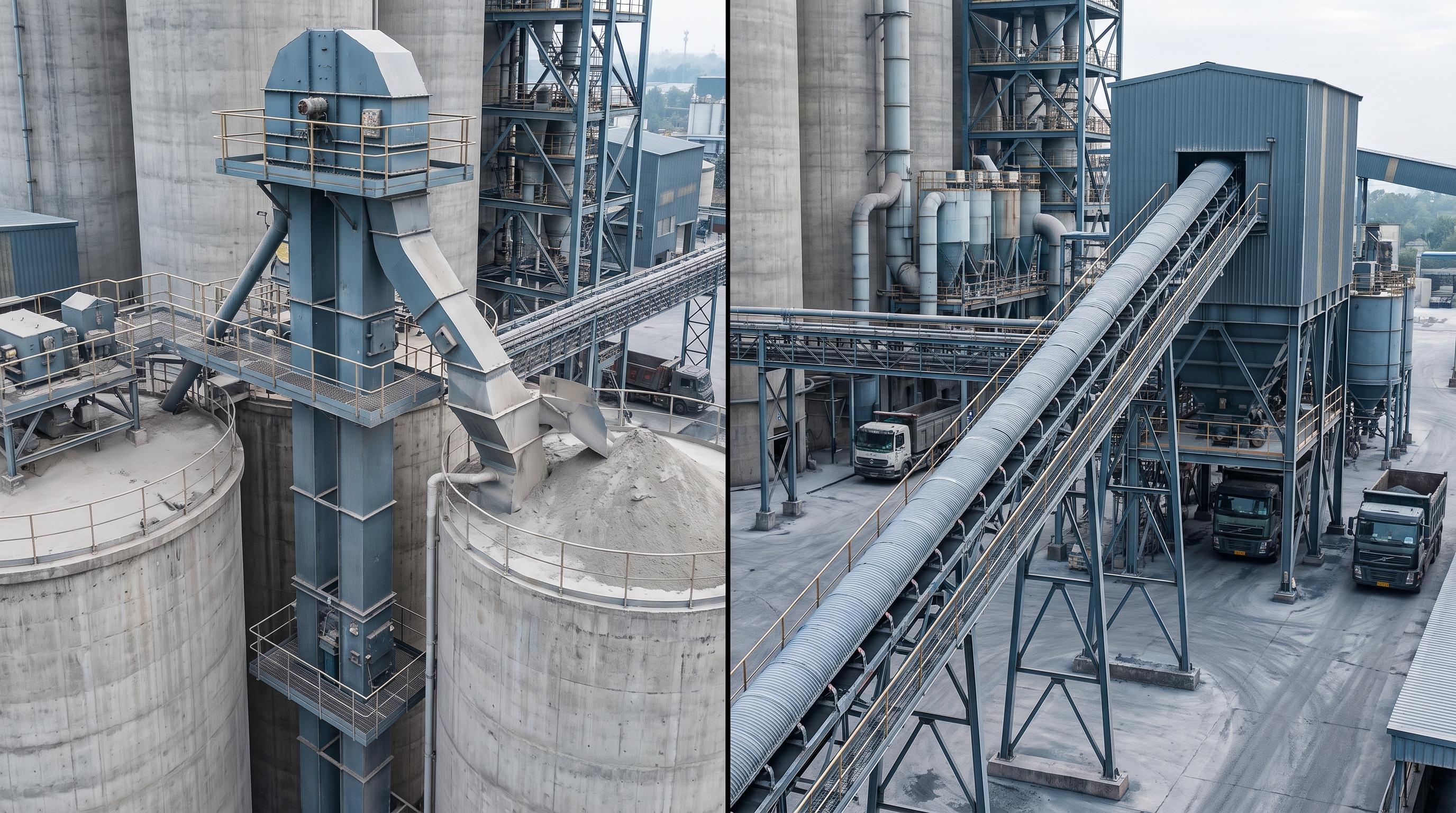
Choose a bucket elevator when you need vertical bulk material handling in a tight footprint. Choose a belt conveyor when you need a long horizontal or inclined run. Do not decide on capacity alone. Check the material, lift height, layout, dust, moisture, maintenance access, and total operating cost before you choose.
In a bucket elevator vs belt conveyor decision, start with the job. Check the lift, route, material, and maintenance plan first. Plant engineers face this choice in cement, power, and bulk solids plants. The wrong choice can raise dust, wear, downtime, and cost.
That choice affects:
Plant footprint
Energy consumption
Material degradation
Dust generation
Maintenance access
Belt and component wear
Transfer-point requirements
Downtime risk
Long-term operating cost
So the question should not simply be, “Which conveyor has higher capacity?”
Compare each option against the real lift, route, material, dust-control needs, and maintenance access. That is how plant teams choose the better fit.
Bucket Elevator vs Belt Conveyor: At a Glance
Factor | Bucket Elevator | Belt Conveyor |
|---|---|---|
Primary use | Vertical conveying | Horizontal and inclined conveying |
Vertical lift | Excellent | Limited for steep inclines |
Horizontal conveying | Not suitable | Excellent |
Footprint | Compact | Requires more horizontal space |
High lift applications | Very suitable | Usually less practical |
Capacity | High, depending on design | Very high |
Material handling | Cement, clinker, fly ash, grain, powders, granules | Ore, coal, limestone, cement, aggregates, bulk solids |
Dust control | Enclosed design helps control dust | Depends heavily on enclosure and transfer-point design |
Maintenance access | Can be more difficult due to vertical arrangement | Generally easier along accessible conveyor sections |
Main wear areas | Buckets, belt/chain, pulleys, bearings | Belt, idlers, pulleys, cleaners, skirting |
Best application | High vertical lift in limited space | Long-distance or inclined conveying |
Typical concern | Belt tracking, bucket damage, boot buildup | Belt mistracking, spillage, idler failure |
Important: Use this table as a guide. Do not use it as the final design rule. Base the decision on the real material, required capacity, lift, temperature, layout, and plant conditions.
When a Bucket Elevator Makes More Sense
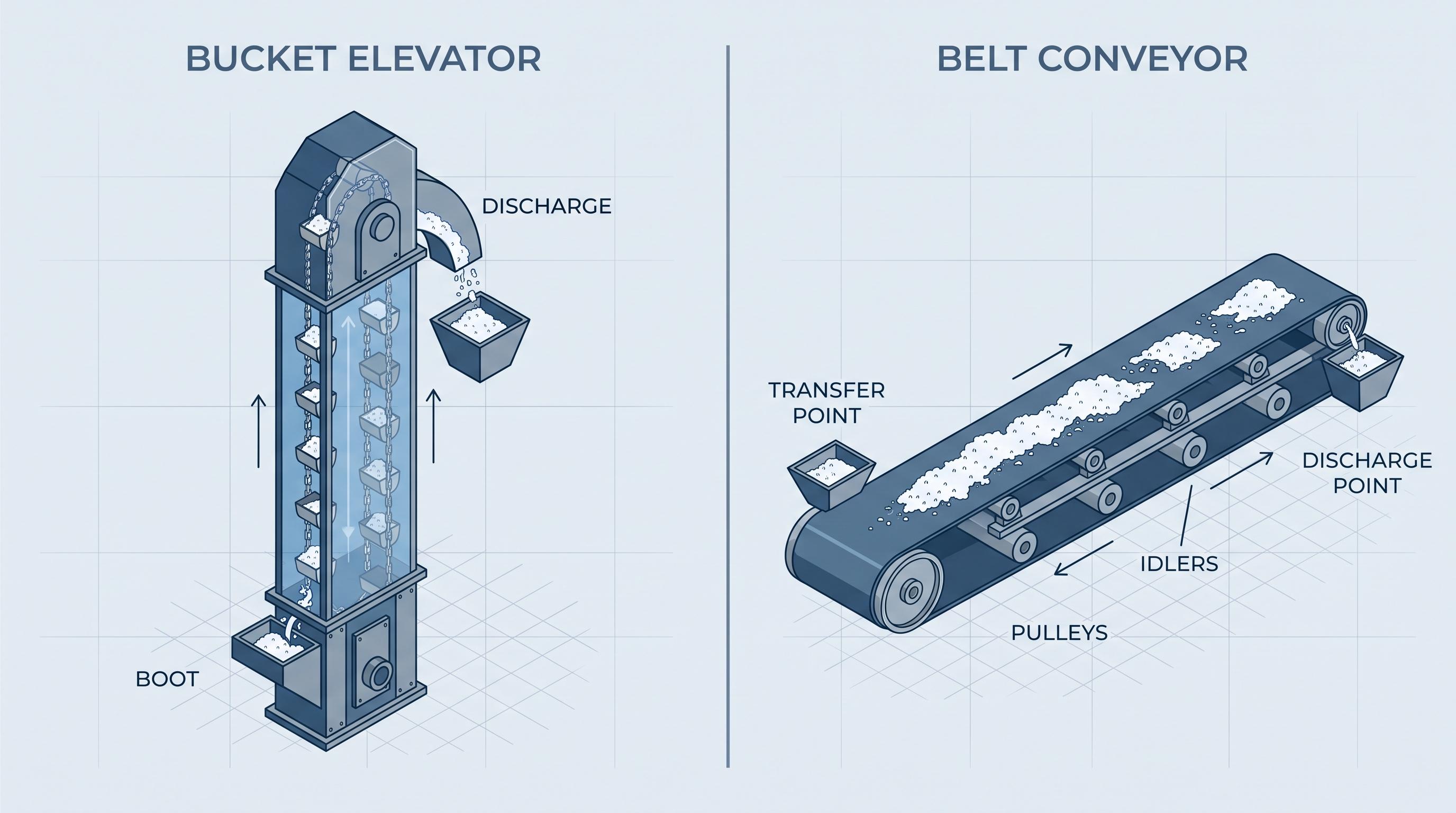
A bucket elevator is designed specifically for vertical bulk material handling.
It uses buckets attached to a belt or chain. The buckets pick up material at the bottom. They discharge it at the top.
This design works well when the plant needs a lot of vertical lift but has limited floor space.
Common applications include:
Cement and clinker handling
Finished cement conveying
Fly ash handling
Limestone and mineral products
Gypsum handling
Fertilizer
Grain and other dry bulk materials
Powder and granular products
Consider a cement plant that must move material from a lower conveyor to a high separator or silo. A long inclined belt can do the job. But it may need too much floor space. A bucket elevator can deliver the same lift in a smaller footprint. That is why many cement grinding and storage systems use bucket elevators.
When a Belt Conveyor Makes More Sense
Belt conveyors are the workhorses of bulk material handling.
They are especially effective when material needs to travel horizontally or over a relatively long distance.
Typical applications include:
Limestone conveying
Coal handling
Ore transportation
Aggregate handling
Clinker transport
Stockyard systems
Ship and truck loading systems
Plant-to-plant material transfer
A belt conveyor can also handle incline work. But the angle must stay within the design limit for the material and the belt.
A coal-fired power plant may use belt conveyors to move coal from receiving and storage areas to the crusher and boiler feed system. The route may run for hundreds or thousands of feet. In that case, a belt conveyor is usually the better fit. The plant needs long-distance movement more than vertical lift.
The Most Important Selection Factors
1. Bucket Elevator vs Belt Conveyor for Vertical Lift
This is often the first question to answer.
If the main job is straight vertical lift, put a bucket elevator high on the shortlist.
If the material must travel a long horizontal distance before it rises, a belt conveyor may be the better choice.
2. Material Characteristics
Do not select conveying equipment based on capacity alone.
Evaluate:
Bulk density
Particle size
Particle shape
Moisture content
Temperature
Abrasiveness
Cohesiveness
Flowability
Dustiness
Degradation sensitivity
Abrasive material can wear buckets, belts, chutes, idlers, and transfer points much faster. That extra wear changes maintenance cost and shortens service life.
Sticky material can create buildup in elevator boots and conveyor loading zones.
3. Required Capacity
Capacity must be considered together with bulk density and material flow.
A system sized for 500 tons per hour of one material may need a different design for another material. Density, flow, and fill behavior can change the result. Match the equipment to the real material, not just the tonnage target.
For a bucket elevator, engineers should consider:
Bucket size
Bucket spacing
Belt or chain speed
Fill level
Material density
Discharge efficiency
For a belt conveyor, key factors include:
Belt width
Belt speed
Loading profile
Idler configuration
Material density
Conveyor inclination
4. Plant Footprint
This is where bucket elevators often have an advantage.
A vertical elevator can achieve substantial lift using a relatively small floor area.
A belt conveyor can move material up over a long route. But it may need much more horizontal space, depending on the incline.
Practitioner observation: In retrofit work, footprint often decides the choice before capacity does. A layout may look fine on paper. It can still fail in the plant if the route is too long or creates too many transfer points.
5. Maintenance and Accessibility
Equipment selection should account for how technicians will actually maintain it.
A bucket elevator concentrates many critical components into a tall vertical structure.
Maintenance teams may need to inspect:
Head pulley
Boot pulley
Bearings
Buckets
Belt or chain
Take-up system
Inspection doors
Backstops
Speed sensors
Plan access and safe work platforms early in the design.
Belt conveyors generally offer easier access to many components, particularly on ground-level sections.
Long conveyor systems bring their own maintenance load. They use many idlers, pulleys, cleaners, skirting parts, and transfer points. Each part adds inspection time. Each part also adds wear and repair work.
Practitioner observation: The cheapest conveyor to buy is not always the cheapest one to run. Maintenance teams often care more about access, spare parts, and repair time than the initial equipment price.
6. Dust and Spillage Control
Dust control is a major concern in cement, power, mining, and other bulk handling facilities.
Bucket elevators are usually enclosed. That helps contain airborne material.
However, the elevator still requires careful design around:
Boot loading
Head discharge
Inspection doors
Seals
Venting
Internal buildup
Belt conveyors require particular attention at loading and discharge areas.
Poorly designed transfer points can cause:
Dust clouds
Material spillage
Belt mistracking
Skirt wear
Cleanup requirements
Good chute design matters for both systems. Good sealing matters too. Dust collection matters as well. So does steady material flow. When those elements are weak, dust and spillage rise fast.
7. Energy and Operating Cost
Energy consumption depends on much more than the conveyor type.
Consider:
Lift height
Conveying distance
Capacity
Material density
Belt speed
Drive efficiency
Mechanical losses
Operating hours
A bucket elevator can be efficient for vertical lift because it is built for that job.
A belt conveyor can be more efficient when bulk material must move a long horizontal distance.
The best approach is to compare the total cost of ownership, including:
Capital cost + power + wear parts + maintenance + downtime + cleaning + expected service life
If you are comparing options for an upgrade or a new line, use a clear spec sheet. It helps the team align on lift, layout, material behavior, and maintenance needs before you request pricing or lock the equipment choice.
Real-World Application Examples
Cement: Finished Cement to Storage
Requirement: Move finished cement from a lower process level to elevated storage or process equipment.
Preferred solution: Bucket elevator.
Why: A bucket elevator provides high vertical lift in a compact footprint. It also helps contain dry bulk powder. Engineers should still check elevator speed, bucket fill, discharge behavior, dust control, and access at the boot and head.
Field note: In cement upgrade work, teams often find that lift height is not the real limit. Service access at the boot and head is. Buildup around the boot inlet can reduce bucket fill. Then a capacity issue turns into cleanup and downtime.
Cement: Limestone to Crushing or Grinding
Requirement: Move large quantities of limestone across a plant over a significant horizontal distance.
Preferred solution: Belt conveyor.
Why: Long-distance bulk transport is where belt conveyors provide a strong advantage.
The engineering focus shifts toward belt width, speed, idler spacing, loading zones, transfer chutes, belt cleaners, and tracking.
Power: Fly Ash to Storage
Requirement: Elevate dry fly ash from collection equipment to a silo.
Potential solution: Bucket elevator, depending on the material properties and system layout.
The enclosed design can help with dusty materials. Engineers should still review moisture, temperature, flowability, and buildup risk before selecting the final arrangement.
Field note: In fly ash projects, one of the first issues teams notice is not always lift capacity. It is buildup and discharge consistency when moisture or temperature shifts. A system that handles dry ash well can become much less stable when those conditions change.
Power: Coal Yard to Boiler Area
Requirement: Move large quantities of coal across a plant.
Preferred solution: Belt conveyor.
Why: The application typically involves long horizontal or inclined runs where continuous belt conveying is practical.
In this kind of system, transfer-point design matters. Belt cleaning matters too. So do fire protection, dust suppression, and monitoring.
Field note: On long coal and bulk fuel routes, the belt itself is often not the first maintenance problem. Teams usually feel the workload at the transfer points, where dust, cleaner performance, and mistracking begin to drive labor hours long before the conveyor reaches its theoretical limit.
Common Mistakes When Selecting Between the Two
1. Choosing Based Only on Capacity
Two systems can hit the same capacity target and still need different designs. Better approach: Review capacity along with material density, particle size, lift, distance, and operating conditions.
2. Ignoring Material Flowability
A material may flow well through a chute in one condition and behave very differently when moisture or fines increase. Better approach: Review the material before you finalize the bucket, chute, and loading design.
3. Underestimating Maintenance Access
A component that is difficult to reach can turn a minor failure into extended downtime. Better approach: Include inspection platforms, access doors, lifting arrangements, and safe maintenance clearances in the original design.
4. Treating Transfer Points as an Afterthought
Transfer points are common sources of dust, spillage, wear, and belt mistracking. Better approach: Engineer material flow from one conveyor to the next rather than treating the transfer chute as a simple connection.
5. Ignoring Future Capacity
A system designed exactly around today's production rate may become a bottleneck after a plant expansion. Better approach: Confirm the expected operating range and future capacity requirements before equipment sizing.
6. Comparing Purchase Price Instead of Lifecycle Cost
A lower initial price does not necessarily mean a lower-cost system.
Better approach: Compare energy, wear parts, labor, downtime, maintenance frequency, and expected service life.
What to Specify Before Selecting the Equipment
Before requesting a bucket elevator or belt conveyor quotation, prepare the following information.
Material Data
Material name
Bulk density
Maximum particle size
Moisture content
Temperature
Abrasiveness
Flowability
Expected material degradation
Process Requirements
Required capacity
Minimum and maximum operating capacity
Vertical lift
Horizontal conveying distance
Conveyor inclination
Operating hours per day
Required availability
Site Conditions
Available footprint
Elevation constraints
Ambient conditions
Dust-control requirements
Maintenance access
Existing equipment interfaces
Electrical and instrumentation requirements
Maintenance Requirements
Specify expectations for:
Inspection access
Bearing replacement
Belt or chain replacement
Bucket replacement
Belt cleaning
Lubrication
Spare parts
Condition monitoring
A detailed specification reduces risk. It helps suppliers size the system for real plant conditions. It also cuts avoidable changes after installation.
Bucket Elevator or Belt Conveyor: Which One Should You Choose?
Use a bucket elevator when:
Vertical lift is the primary requirement
Floor space is limited
Material is suitable for bucket handling
Enclosed conveying is valuable
The system requires a compact vertical transfer
Use a belt conveyor when:
The conveying route is primarily horizontal
Material must travel long distances
High continuous capacity is required
Easy access to many components is important
The layout supports a conventional conveyor route
In some plants, the best answer is not either-or. A belt conveyor may handle the horizontal run first. A bucket elevator may then handle the final vertical lift. This layout can create a cleaner and more practical material path when the process needs both.
Key Takeaways
Bucket elevators are purpose-built for vertical bulk material handling.
Belt conveyors are generally better for long horizontal and moderate-incline conveying.
Capacity alone should never determine equipment selection.
Material characteristics can significantly affect equipment performance and wear.
Footprint and maintenance access are critical design considerations.
Transfer points, dust control, and spillage should be engineered early.
Lifecycle cost is more useful than purchase price when comparing systems.
In many plants, a belt conveyor + bucket elevator combination can provide the most practical material flow.
The right answer in a bucket elevator vs belt conveyor comparison depends on the material, route, lift, maintenance plan, and lifecycle cost. Choose the system the plant can run safely. Choose the one the team can maintain with confidence.
Frequently Asked Questions(FAQ)
A bucket elevator is primarily designed to move bulk material vertically using buckets attached to a belt or chain. A belt conveyor uses a continuous belt and is generally better suited to horizontal and inclined material transport over longer distances.
For applications requiring significant vertical lift in a compact footprint, a bucket elevator is often the more practical choice. The final selection depends on material properties, capacity, lift height, layout, and maintenance requirements.
A belt conveyor can move material on an incline, but its practical angle is limited by material characteristics and belt design. For substantial vertical lifting, a bucket elevator is generally more suitable.
Neither system is automatically easier to maintain in every application. Bucket elevators require attention to buckets, belts or chains, bearings, pulleys, and alignment. Belt conveyors have many wear components, including belts, idlers, cleaners, pulleys, and skirting.
Both are widely used. Bucket elevators are particularly useful for vertical movement of cement and other dry bulk materials, while belt conveyors are commonly used for longer horizontal or inclined material transport such as limestone and clinker handling.