
Bulk Material Handling
How to Choose the Right Industrial Damper for Cement and Power Plants

Vijay Baid
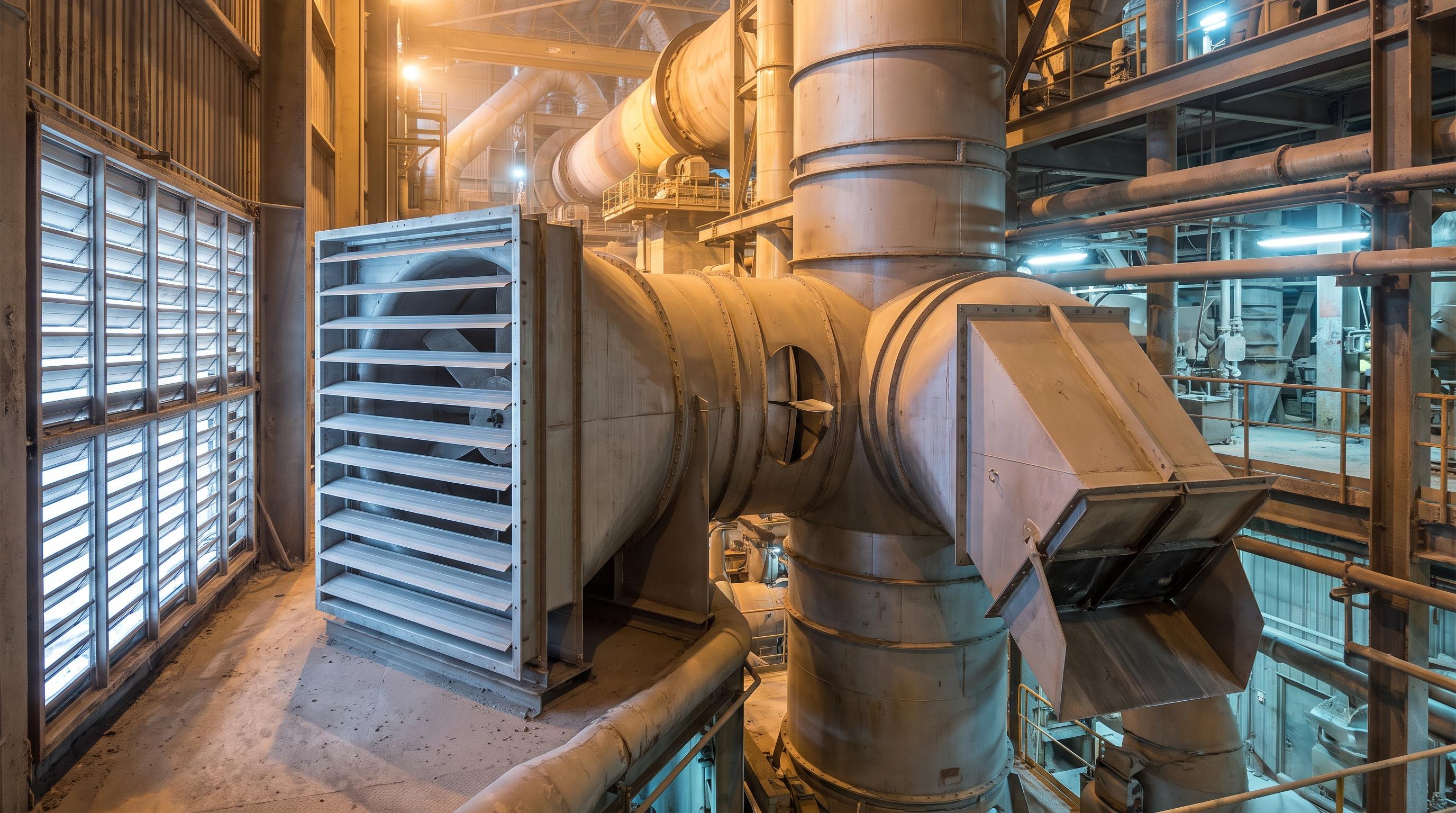
Pick a damper by the job it has to do, not by what it is called.
There are four jobs in a cement or power plant. Modulate gas volume in one duct. Regulate or isolate ventilation air. Divide flow between two paths. Pass material through a chute while holding a gas seal.
Each job has a type that fits it. Get the job right and the type follows.
This guide walks through the four jobs, which damper belongs at each, and what the type does not decide.
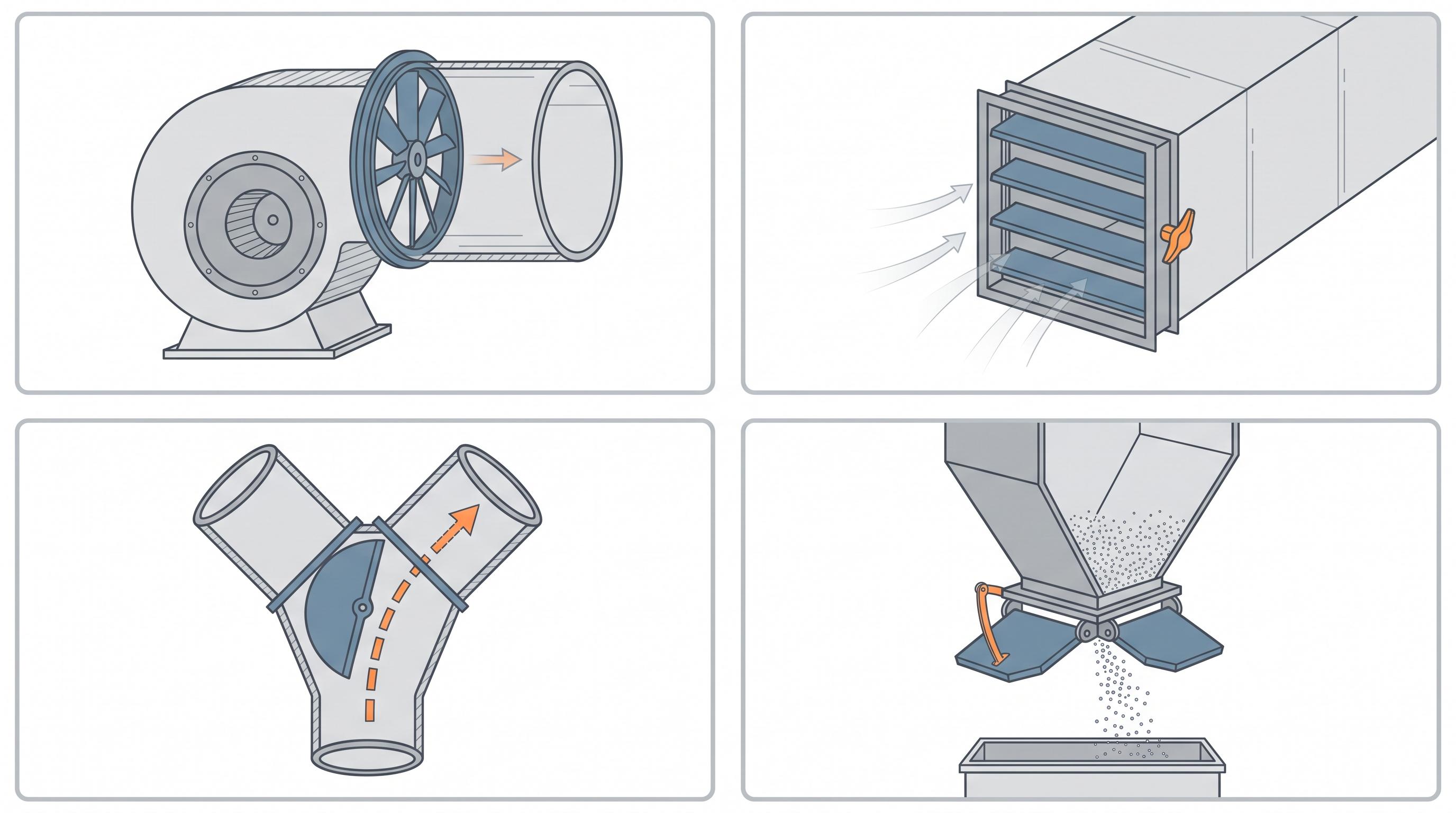
Kiln ID fan or preheater fan inlet, where you are trimming gas volume, wants a parallel damper. Cooler vents, baghouse compartments, and fresh air intakes want a multi louvre. A preheater string or kiln bypass that splits flow two ways wants a splitter. A clinker chute or bag filter hopper that has to pass material and still seal wants a double flap.
Industrial damper applications at a glance
Start here. Find your job, then read that section.
The job | Where it shows up | The type |
|---|---|---|
Modulate gas volume in one duct | Kiln ID fan inlet, preheater fan, raw mill circuit | Parallel damper |
Regulate or isolate ventilation air | Clinker cooler vents, baghouse compartments, fresh air intake | Multi louvre damper |
Divide flow between two paths | Preheater strings, kiln bypass, ESP inlet balancing | Splitter damper |
Pass material and hold a gas seal | Clinker cooler discharge, raw meal, coal feed, bag filter hoppers | Double flap damper |
Note the last one. A double flap is not an airflow device. It is a material device that happens to seal gas, and that is why it keeps getting compared to the wrong things.
Parallel damper applications for fan inlet and gas flow control
This is the fan inlet job, and it is the one most plants are asking about.
Your kiln ID fan pulls a set draft. The preheater fan and the raw mill circuit need stable gas volume. When you are trimming that volume up and down against a setpoint, you want a parallel damper. At a fan inlet the parallel-blade arrangement is the throttling choice, not the isolating one, because it spins the gas the way the fan turns and trims volume while easing fan load.
What makes it fit:
Blades move in unison. Six to twenty of them on a synchronized linkage, so the whole stack opens and closes together for uniform regulation.
It modulates, not just opens and shuts. An electric actuator on 4 to 20 mA control positions it precisely, which is what a draft loop needs.
It stays out of the way when open. A low-resistance aerodynamic blade profile keeps pressure drop under about 0.6 in. w.c. at rated flow, fully open. That matters, because a damper that sits open most of the year is a fan-power bill you pay every hour.
It handles the heat. Continuous duty to about 840°F covers preheater and kiln gas ducts, and it is built up to roughly 13 ft square for large ID fan inlets.
For the fan and gas duct side of a cement plant, and for the same duty in a power plant, this is the type.
Multi-louver damper applications for ventilation and isolation
Different job, cooler air, different damper.
Clinker cooler ventilation, baghouse compartment isolation, and fresh air intake are not kiln gas duct work. The temperatures are lower, the duty is often ventilation rather than process trim, and sometimes you just need to shut a compartment off.
A multi louvre damper covers that range:
Blade action is selectable. Opposed-blade when you are throttling, parallel-blade when you are isolating. Same damper, specified for the duty.
Actuation matches the need. Manual hand lever where someone sets it and leaves it. Gear-operated or electric with a positioner where it moves regularly.
It is rated for leakage, not just described as tight. Class II low-leakage to AMCA 500-D at 4 in. w.c. test pressure. Ask for that number rather than an adjective.
It runs to about 660°F on process air, with ambient-rated options for straight ventilation, in sizes from 12 in. square up to roughly 8 ft.
Deciding between two types for the same duct? The spec sheet is a good next step before you commit.
Splitter damper applications for flow diversion and balancing
If the duct forks, you are in splitter territory.
Preheater strings need gas balanced between them. A kiln bypass needs a share of the flow diverted. An ESP inlet needs the gas spread evenly across the field. None of that is throttling. It is proportioning.
A splitter damper has a splitting blade that divides the stream between two outlets, anywhere from 0 to 100 percent. Pneumatic or electric actuation with a manual override, to about 840°F, from 24 in. square up to roughly 10 ft.
Do not use a throttling damper to do a splitter's job. A damper built to restrict one duct will starve one leg while the other runs away, and you will spend the next year chasing a balance that was never available.
Where the gas is carrying abrasive dust, ceramic-lined internals are worth specifying. Preheater and bypass gas is not kind to a blade that sits in the middle of the stream.
Double flap damper applications for material discharge and gas sealing
This job has nothing to do with airflow control, which is exactly why it gets confused.
Clinker cooler discharge, raw meal transport, coal feeding, and bag filter hoppers all have the same problem. Material has to fall through, and gas must not come back up.
A double flap damper solves it with two flaps in series. One opens while the other stays shut, so there is never an open path from one side to the other. That is an airlock, built without a rotor.
Why plants pick it:
No rotating element in the material path. Counter-weighted flaps self-close, with a pneumatic actuator if you want remote control.
It seals hard. Dual flap metal-to-metal, near-zero leakage at about 20 in. w.c. in either direction.
It survives the material. AR400 abrasion-resistant steel with replaceable wear liners, rated to about 750°F.
If your problem is gas coming back up a chute, this is the type. If your problem is trimming a fan, it is not.
What to specify beyond damper type
Picking the type is the first decision, not the last.
Temperature sets the material. Preheater and kiln gas duct duty runs hot enough to need a high-temperature austenitic in the blades. Cooler ventilation does not. Give us the real operating temperature, including upsets, not the number on the heat balance.
Dust sets the wear package. Raw meal, kiln dust, and clinker fines cut steel. Where the blade sits in the stream, ceramic lining or abrasion-resistant plate is the difference between a damper you adjust and a damper you replace.
The duty cycle sets the actuation. A damper that trims all shift wants a modulating actuator. One that moves twice a year does not. Paying for 4 to 20 mA control on an isolation damper is money that buys nothing.
The U.S. Department of Energy’s fan systems guidance makes the same point: total system pressure comes from the combined losses across the full system. That is why damper pressure drop should be evaluated as an operating-cost issue, not just a purchase-cost detail.
Common damper selection mistakes
Picking the type from the catalog before working out the job
Using a throttling damper where the duct actually splits two ways
Comparing a double flap against airflow dampers, when it is a material device
Specifying blade material to steady-state temperature and losing it in an upset
Buying modulating actuation for a damper that only isolates
Accepting low leakage as a claim instead of an AMCA 500-D class
How to specify the right industrial damper
Most plants do not need a longer shortlist. They need the right damper for the duty in front of them.
Once the job is clear - fan trim, compartment isolation, flow split, or material discharge with a gas seal, the rest of the selection gets simpler. Operating temperature, dust loading, and how often the damper moves tell you what materials, wear package, and actuation the build needs.
Because we build all four types for cement and power plants, the recommendation starts with the application, not the margin. If you are sizing for a live duty, a quick engineering review usually settles the right type and build details faster than another round of comparison.
Key Takeaways
Pick by the job: modulate one duct, regulate ventilation, split two paths, or pass material and seal.
Kiln ID fan and preheater fan trim is parallel damper work. Cooler vents and baghouse compartments are multi louvre work.
If the duct forks, use a splitter. A throttling damper will starve one leg.
A double flap is a material device with a gas seal, not an airflow damper. Do not compare it to one.
The type does not set the blade material, the wear package, or the actuation. Temperature, dust, and duty cycle do.
Industrial damper selection FAQ
A parallel damper. The job there is trimming gas volume against a setpoint, which needs blades that move in unison on a synchronized linkage and an actuator that can position them precisely, usually electric on 4 to 20 mA control. Look for a low-resistance blade profile too, because the damper sits open most of the year and its open pressure drop is fan power you pay for continuously.
A splitter divides flow between two outlet paths, anywhere from 0 to 100 percent. A throttling damper restricts flow in a single duct. They are different jobs. Using a throttling damper where the duct forks tends to starve one leg while the other runs away, because it was never built to proportion flow between two paths.
No. It is a material device that holds a gas seal. Two flaps work in series so one is always closed, which lets material fall through a chute while gas cannot come back up. It suits clinker cooler discharge, raw meal, coal feed, and bag filter hoppers. It is not for trimming a fan.
It depends on the type and the build. Parallel and splitter dampers for preheater and kiln gas duct duty run to about 840 F continuous. Double flap dampers for hot gas isolation run to about 750 F. Multi louvre dampers for process air run to about 660 F, with ambient-rated options for ventilation. Specify against upset temperatures, not the steady-state figure.
Ask for a leakage class tested to AMCA 500-D at a stated test pressure, not a description. A Class II low-leakage rating at a named pressure is a number you can compare. Tight sealing is not.
Only where the blade sits in an abrasive stream. Preheater gas, kiln bypass, and ESP ducting carry raw meal and clinker fines that cut steel, and there ceramic-lined internals or abrasion-resistant plate earn their cost. On clean ventilation air they do not.