
Bulk Material Handling
How to Size an Air Slide for Cement and Fly Ash: Slope, Air Volume, and Fabric

Vijay Baid
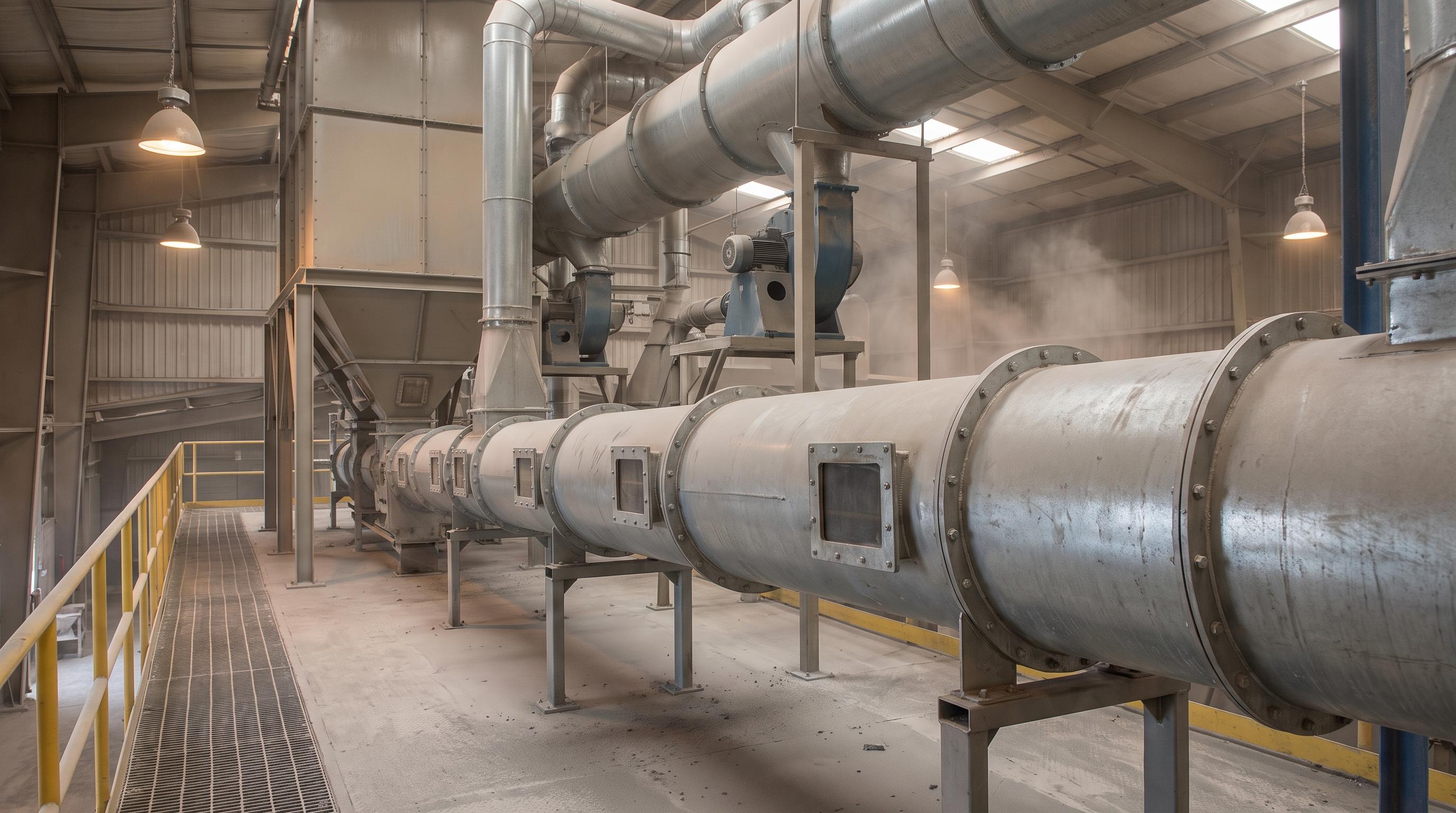
An air slide has no drive, no chain, and no rotating element in the material path. It has three numbers. Slope, air volume per square foot of fabric, and fabric permeability.
Get those three right and the unit runs for years on a fractional-horsepower blower. Get one wrong and the cost shows up fast: plugged runs that force a shutdown, cleanup labor under transfer points, unstable downstream feed, and fabric replacements that treat the symptom instead of the cause. Most air slide problems trace back to sizing, not hardware. The fabric takes the blame because the fabric is what you can see when you open the cover.
This guide covers the order United Global sizes those three numbers in for cement, raw meal, and fly ash duty in US plants, and why the material test decides the slope more than the catalog does.
Fluidized powder behaves like a liquid, so gravity does the conveying and the air only keeps the bed aerated. Set slope from the material, typically 6° to 10° for cement powders. Supply 4 to 8 SCFM per square foot of fabric at roughly 1.5 to 4.4 PSI. Match fabric permeability and temperature rating to the powder, not to the plant’s ambient. Size the air on fabric area, never on tonnage.
Why air slides are sized on fabric area, not tonnage
Because gravity does the conveying. The air does not push powder along the channel.
Low-pressure air enters the plenum below the fabric and passes up through it. That air separates the particles just enough to break interparticle friction. Once the bed is aerated, the powder loses its angle of repose and behaves like a fluid with roughly the viscosity of water. Then it runs downhill.
The blower’s only job is to hold the bed in a fluidized state. It is not moving tons. It is holding a condition, across an area. That is why the air calculation keys off square feet of fabric and the tonnage calculation keys off slope and cross-section. They are two different problems and they get solved in that order.
It also explains the failure mode. When fluidization stops, the slide does not slow down. It stops. There is no drive to push through a partial blockage. The bed slumps, the material sets, and what should have been a sizing decision becomes lost production time, cleanup work, and an emergency maintenance job.
How do you size an air slide?
Five inputs, in this order. Each one closes off the next.
# | Input you provide | What it decides |
|---|---|---|
1 | Material and its moisture band across a full year | Slope, and whether an air slide is the right device at all |
2 | Available drop between inlet and outlet | Whether the slope you need will physically fit |
3 | Channel width and length | Fabric area, and therefore blower SCFM |
4 | Temperature at the pickup point | Fabric type |
5 | Tonnage and aerated bulk density | Bed depth and channel cross-section |
The sequence matters. Set slope first, because the material decides it. If the drop available cannot fit that slope, no blower selection will rescue the layout.
Input 1 also sets the compliance scope. Cement, raw meal, and fly ash are not combustible, so NFPA 660 combustible dust requirements do not apply to them. Pulverized coal and petcoke are different and belong inside the plant’s Dust Hazard Analysis.
Step 1: What slope does your material need?
Between 6° and 10° for most cement plant powders. The number comes from the material, not the layout.
Well-fluidizing powders need less slope. Coarser, more cohesive, or moisture-loaded powders need more. US drawings call slope in inches per foot, so both are shown here.
Material | Typical slope | Rise per foot |
|---|---|---|
Raw meal | 6° to 8° | 1.3 to 1.7 in./ft |
Fly ash (dry, conditioned) | 6° to 8° | 1.3 to 1.7 in./ft |
Portland cement, finish mill | 8° to 10° | 1.7 to 2.1 in./ft |
Cement kiln dust | 8° to 12° | 1.7 to 2.6 in./ft |
Marginal or moisture-variable powder | 10° to 12° | 2.1 to 2.6 in./ft |
Treat these as a starting point for layout, not a specification. The number that matters is the slope your material needs at its worst moisture, not its average moisture.
More slope is not free. Steeper runs eat headroom you may not have between a silo outlet and a receiving point. And a slide steep enough to handle the wettest week of the year can run away from you in the driest, which is a problem covered further down.
Where a slope past 12° gets specified, it usually means the material was never tested and somebody bought margin instead of data.
Step 2: How much air per square foot of fabric?
Between 4 and 8 SCFM per square foot, at roughly 1.5 to 4.4 PSI.
Size the air on fabric area, not on tonnage. This is the sizing mistake we see most often. A blower selected against TPH ends up oversized on a short run and starved on a long one.
The math is short. Fabric area is channel width times length. Multiply by the aeration rate. Fine, well-fluidizing powders like raw meal sit near 4 to 5 SCFM/ft². Cement and cohesive powders sit higher, 6 to 8 SCFM/ft².
Worked example: A 12 in. wide slide running 20 ft has 20 ft² of fabric (1 ft × 20 ft). At 6 SCFM/ft², that is 120 SCFM. Add margin for plenum leakage and fabric aging and specify roughly 140 to 150 SCFM. Note what never entered the calculation: tonnage.
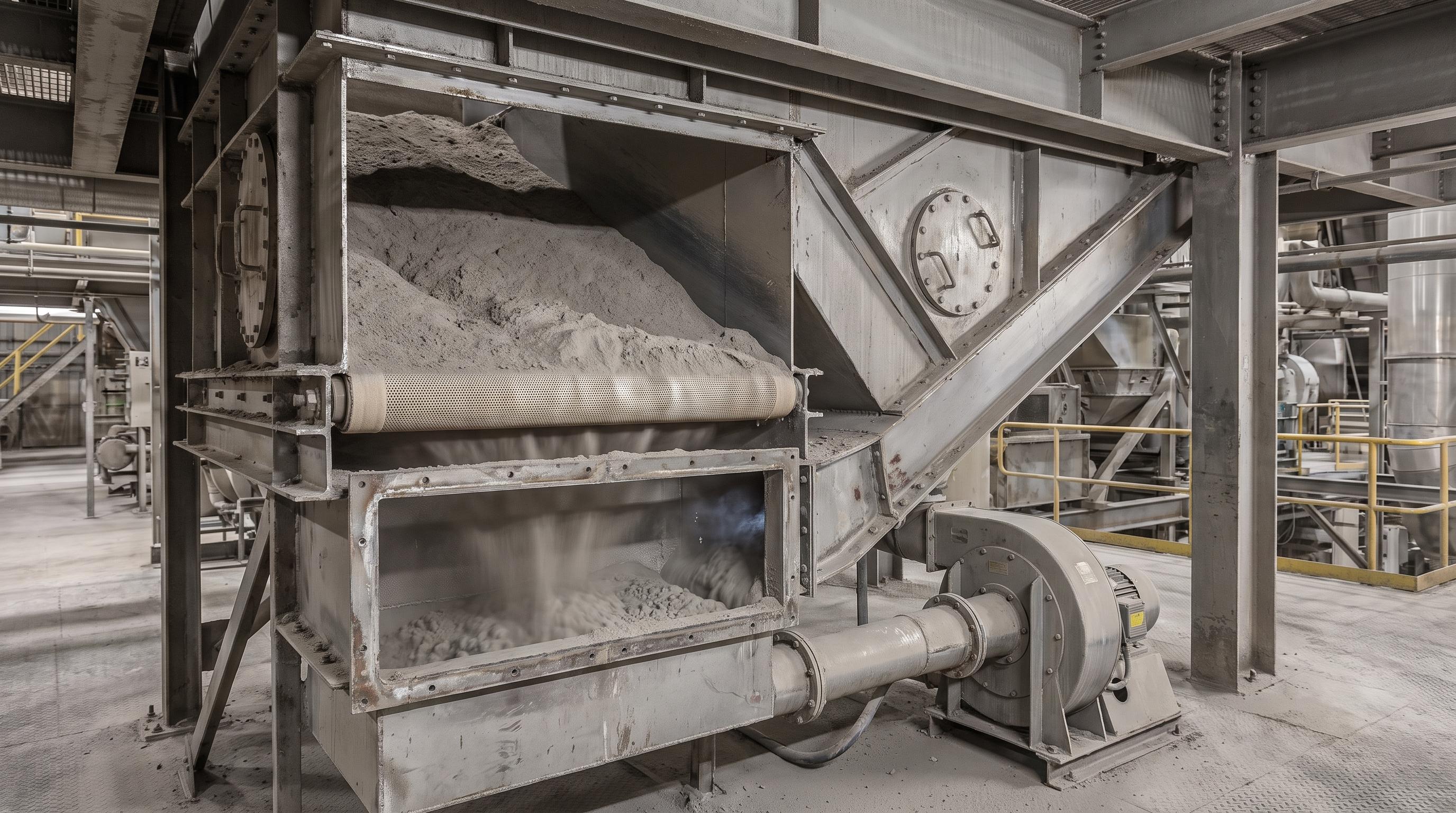
Blower pressure has to overcome three things: fabric resistance, the weight of the fluidized bed above it, and duct losses. That is why pressure and capacity are linked, even though air volume is still sized from fabric area.
Air slides are low-pressure devices. If someone quotes a positive-displacement blower at 8 PSI for an air slide, they are sizing a pneumatic conveying line, not a fluidized gravity conveyor.
One detail often left to the electrical package: specify the blower motor enclosure for the real environment. A blower on a Gulf Coast silo roof does not live in the same conditions as one inside a conditioned MCC room.
Running this calculation against a real duct? The spec sheet carries the fabric, pressure, and capacity data to check a selection before you commit to a layout.
Step 3: Which fabric matches the powder?
Two ratings decide it. Permeability first, temperature second.
Permeability is a measured value, not an adjective. Ask for it tested to ASTM D737, the US standard method for air permeability of textile fabrics, expressed in CFM/ft² at 0.5 in. w.g. A supplier who answers “high permeability” is describing a feeling.
Permeability has to match the powder. Too tight and the blower cannot push enough air through to fluidize the bed. Too open and air blows through in channels while the powder between them sits still.
Temperature rating is where specifications quietly fail:
Fabric | Continuous limit | Where it fits |
|---|---|---|
Nylon (polyamide) | ~200 to 220 °F | Dry, mild service. See the moisture note below. |
Polyester (PET) | ~275 to 300 °F | The workhorse for cement, raw meal, conditioned fly ash |
Aramid | ~400 °F | Fly ash pulled hot off ESP hoppers |
In a humid plant, specify polyester and avoid nylon. Nylon absorbs far more atmospheric moisture. The fibers swell, permeability drops, and the fabric blinds faster. What looks like a maintenance problem is often the wrong fabric for the climate.
Check fly ash temperature at the hopper, not at the silo. Ash coming off an ESP hopper in a coal-fired plant can arrive well above what polyester tolerates. Ash that has sat and cooled is a different specification from ash pulled hot. Same material on the P&ID. Different fabric.
Step 4: Will the channel carry the tonnage?
Bed depth and channel width, working against the slope set in Step 1.
Two material properties drive this and both get assumed instead of measured:
Aerated bulk density, not packed. Portland cement runs roughly 70 to 90 lb/ft³ aerated against 90 to 110 lb/ft³ packed. Fly ash swings harder, near 35 to 45 lb/ft³ aerated against 55 to 75 lb/ft³ packed. Size the channel on aerated density. Size anything downstream that has to hold the material on packed density.
Particle size. Air slides want powder finer than about 200 microns, roughly 70 mesh. Cement, raw meal, and fly ash sit well inside that. Coarse fractions do not fluidize, so they migrate to the bottom of the bed, build up along the fabric, and slowly convert your aeration area into a floor.
Both numbers come from a fluidization test on your actual material at your actual moisture. A moisture figure copied off a two-year-old drawing is not a specification. It is a guess with a revision number.
Why do correctly sized air slides still fail?
Because the material changes with the season and the sizing does not.
Air slides can fail in opposite ways across the same year. Wet months usually cause blinding. Dry months usually cause flooding.
Humid months bring blinding. Cement, kiln dust, and fly ash pull moisture from the air. Damp fines lodge in the fabric, permeability falls, and fluidization goes patchy before the slide finally plugs.
Dry months bring flooding. The same powder, when drier and fully aerated, can outrun the downstream equipment. Then the problem shifts from plugging to overfeeding valves and gates.
Design for the full moisture band, not one reading. A slide sloped for February can flood in August. A slide sloped for August can plug in February.
Keep this simple: if dust starts showing up under the slide, around plenum joints, or near access covers, treat it as a seal failure, not just a housekeeping issue. That usually points to worn fabric edges, loose covers, or failed gaskets letting fines escape into the work area. In plants working under MSHA or OSHA silica rules, the right response is immediate inspection of seals, fabric edges, and covers before the leak becomes a repeat cleanup and exposure problem.
Field rule: If an air slide fluidizes on startup and dies an hour later, suspect the fabric. If it fluidizes some days and not others, suspect the material. Pull a moisture sample the next time it fails and compare it to the figure on the original drawing. The gap between those two numbers is usually the whole story.
Sitting on a slide that fluidizes some days and not others? Send the moisture sample from a day it failed, and we will tell you whether you are looking at a fabric problem or a material problem before you buy either.
The five inputs that separate a real sizing exercise from a catalog quote
An air slide is not selected by model number. It is sized from operating conditions.
The five inputs that actually determine the design are the material, the full-year moisture band, the required tonnage, the available drop between inlet and outlet, and the temperature at the pickup point. Together, those inputs tell you whether an air slide is the right fit for the duty and, if it is, what slope, fabric, and blower duty the job really needs.
If an existing slide only plugs seasonally, the most revealing data point is the moisture condition on a failure day. That is usually where the sizing gap shows up, because average conditions rarely explain why a system runs in one month and fails in another.
Construction details, fabric options, pressure range, and standard capacities still matter, but they only become useful once the duty is defined. Before that, model-to-model comparisons can look precise while hiding the assumptions that actually decide performance. If you want to see how the hardware is built and how the standard range is configured, our Air Slide Assemblies page is the right place to review the construction side of the decision.
For a buyer, the goal is not to collect more technical paperwork. It is to get to a number you can trust. When these five inputs are clear, the sizing can be tied to the actual duty, which means you can compare project cost against the recurring cost of plugging, cleanup labor, unstable feed, lost throughput, and premature fabric replacement. If you already have those conditions in mind, the next step is to request a quote built around the real service rather than a catalog assumption.
Key takeaways
Set slope before anything else. If the available drop cannot accommodate the slope your material needs, the blower selection is irrelevant.
Ask for fabric permeability tested to ASTM D737 in CFM/ft². Reject “high permeability” as an answer.
Specify polyester over nylon anywhere humidity is seasonal. It is a moisture-regain decision, not a quality one.
Rate the fabric against the temperature at the pickup point, not the silo and not the ambient.
Put a controlled feed device downstream and size it for the dry season, because the same slide that plugs in February will try to flood it in August.
Frequently asked questions
Between 6° and 10° for most cement plant powders, or roughly 1.3 to 2.1 inches of rise per foot. Raw meal and dry fly ash fluidize well and sit near the low end. Portland cement and kiln dust need more. Moisture-variable material needs 10° to 12°. Set the angle from a fluidization test at the material's worst-case moisture, because a slide sloped for average conditions will plug in the wet season.
Roughly 4 to 8 SCFM per square foot of fabric, at about 1.5 to 4.4 PSI. Size it on fabric area, which is channel width times length, not on tonnage. A 12 in. wide, 20 ft slide has 20 ft² of fabric, so at 6 SCFM/ft² it needs about 120 SCFM before margin. Sizing a blower against TPH produces a unit that is oversized on short runs and starved on long ones.
Only with the right fabric. Ash pulled hot from an ESP hopper can exceed the continuous rating of polyester, which runs about 275 to 300 °F. Ash that has cooled in a silo is an easier duty. Check the temperature at the actual pickup point rather than the silo, because the same ash on the same P&ID can call for two different fabrics depending on where the slide taps in.
Most likely fabric blinding from atmospheric moisture. Cement, kiln dust, and fly ash are hygroscopic, and Gulf Coast and Southeast humidity runs 70% to 90% for months. Damp fines lodge in the fabric weave, permeability drops, and fluidization goes patchy. Nylon fabric makes it worse because nylon's moisture regain is roughly ten times polyester's, so the fibers swell and close the weave.
About 200 microns, roughly 70 mesh. Cement, raw meal, and fly ash sit comfortably below that. Coarse fractions do not fluidize, so they settle to the bottom of the bed, accumulate along the fabric, and progressively reduce the aerated area until the slide stops moving material.