
Engineering Guides
What Plant Engineers Should Review Before Increasing Conveyor Throughput

Vijay Baid
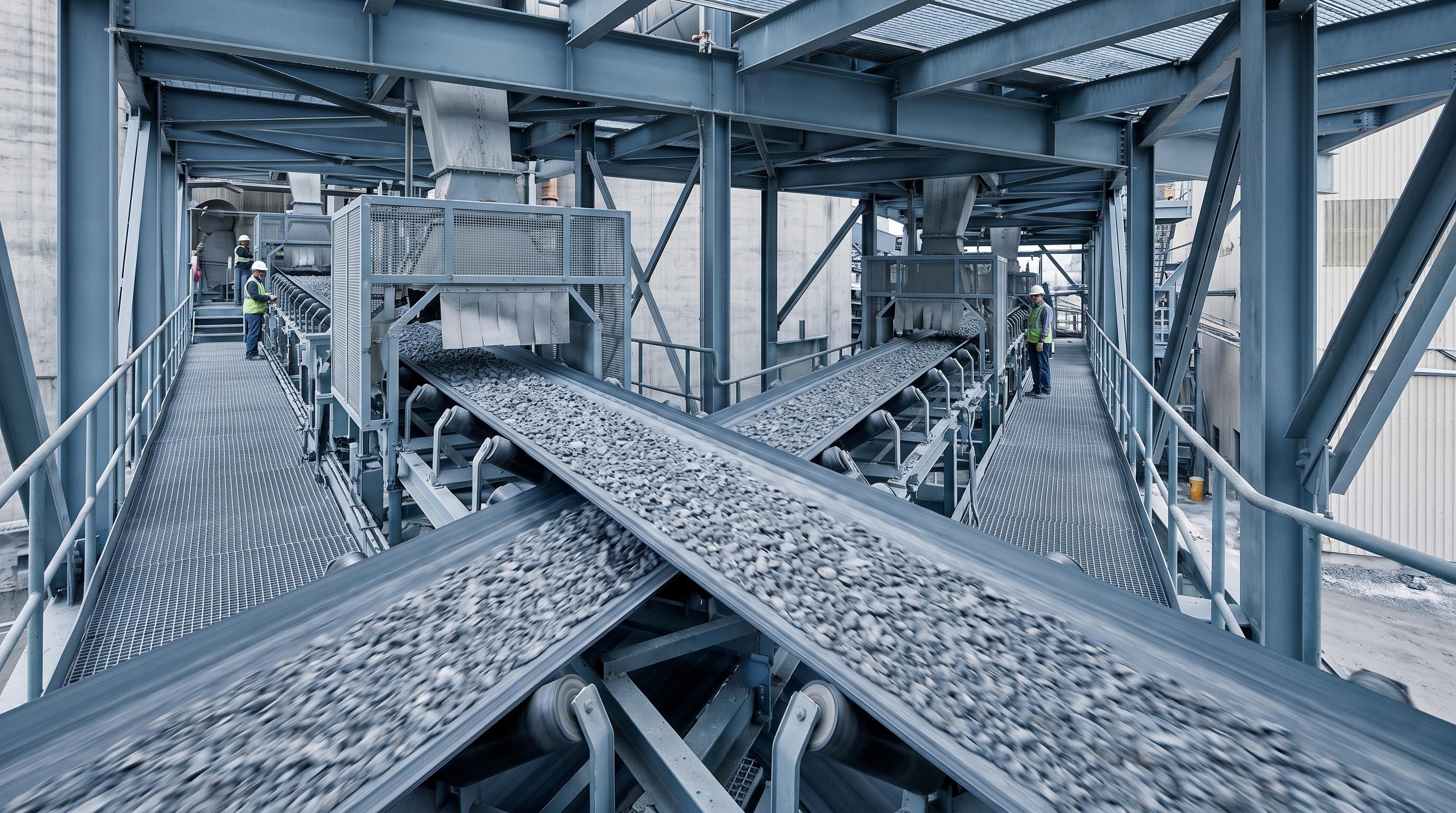
Before you increase conveyor throughput, review loading, transfer points, drive limits, containment, and downstream capacity as one system. Most failed upgrades start with unstable loading or transfer-point losses, not a lack of belt speed. If the line already shows dust, spillage, or mistracking, fix those issues before you raise the setpoint.
If you want to increase conveyor throughput, start with the full system, not just belt speed. In most plants, the limit is somewhere else. It is often a loading issue, a transfer-point issue, a drive limit, or a downstream restriction that shows up when tonnage goes up.
A rushed capacity increase can trigger a familiar chain of problems. You may see off-center loading, skirt leakage, carryback, mistracking, chute plugging, dust release, and more cleanup. A better approach is to find the true bottleneck first. Then decide whether you need a speed increase, a retrofit, or a wider upgrade.
Plant engineers and maintenance teams should keep this review practical and field-driven. Walk the line. Compare operating data with actual conditions. Then make changes the plant can sustain shift after shift.
Why throughput projects fail when the review is too narrow
A conveyor can look capable on paper and still become unstable in service. Average tons per hour do not tell you what happens during surges, wet-material conditions, off-center loading, or a cold start under load.
That is why the first engineering question should be simple: what is the first point in the material path that loses control when throughput increases?
In cement plants, that is often the loading zone or the receiving transfer. In coal and ash handling at power plants, it is often dust containment, buildup, or a chute that does not discharge consistently at higher feed rates. In bulk terminals and quarry systems, it is often impact, skirt sealing, or downstream surge behavior.
Review the Full Material Path Before You Increase Conveyor Throughput
Start at the feed point and follow the material all the way to discharge. Review every transition where the burden changes direction, accelerates, settles, or transfers into another piece of equipment.
Your review should answer these questions first:
Is the material entering the belt in the direction of travel and near the centerline?
Do surge rates exceed the design assumptions used in the original calculation?
Does the downstream receiving point have enough volume, settling distance, and containment?
Are there existing signs of distress, such as belt edge wear, recurring cleanup, or chute plugging?
Will higher throughput change moisture behavior, particle degradation, or dust release?
This step sounds basic, but it prevents expensive mistakes. A higher setpoint on one conveyor does not create stable plant capacity if the upstream feeder, discharge chute, crusher, screen, silo inlet, or downstream belt cannot support the new burden.
Check belt loading, cross-section, and real operating capacity
Real conveyor capacity depends on how the material sits on the belt during actual operation. It is not only about motor size or belt width. Plant engineers should check the real burden profile, freeboard, trough shape, and loading stability before approving any increase.
Review these variables together:
Belt width, trough angle, and transition distance
Material bulk density, lump size, and moisture range
Loading-zone length and burden settling distance
Skirtboard geometry, seal condition, and sealing pressure
Peak loading profile, not just average tons per hour
If the belt already runs near its practical cross-sectional limit, more speed will usually magnify the problem. A burden that is unstable at current conditions will not become more stable when it moves faster.
For U.S. plants, use CEMA guidance as a check, not a shortcut. Compare the original design basis with what the conveyor actually sees in daily operation.
Validate drives, pulleys, and starting conditions
Higher throughput changes more than running horsepower. It can affect starting torque, belt tension, pulley traction, take-up behavior, and heat load on the drive system.
The drive review also matters because motor-driven systems consume more than two-thirds of manufacturing electricity use, according to the U.S. Department of Energy. Even when the main goal is more tons per hour, changes in drive loading and operating profile can affect energy cost, heat load, and long-term reliability.
Before increasing throughput, check:
Motor loading at current peaks, not just normal averages
Reducer service factor under the revised duty
Drive-pulley traction and lagging condition
Take-up travel and response during transient loading
Loaded starting behavior during upset and wet-material conditions
Bearing and shaft limits on pulleys in the revised operating envelope
This matters in practice because some systems look acceptable until the first heavy start after a shutdown. If you only review calm operating data, you can approve a capacity increase that fails the first time the line restarts under a difficult load.
Practitioner observation: On many brownfield upgrades, the drive is not the first thing that fails. The first sign is usually slip, mistracking, or unstable loading at the transfer, and the drive problem shows up only after the rest of the system has already lost control.
Maintenance burden also rises fast when material control breaks down. Martin Engineering has noted that carryback can account for up to 85% of conveyor maintenance problems in some systems. That is why cleanup history and belt-cleaning performance deserve a formal check before any throughput increase is approved.
Evaluate transfer points, chutes, dust, and spillage control
Transfer points often decide whether a throughput increase will work in the field. If the chute does not load the belt in the direction of travel, control impact, and manage air movement, higher throughput usually means more dust and more spillage.
Dust control is not a minor side issue in these reviews. OSHA cites a U.S. Chemical Safety Board review that found 281 combustible-dust incidents between 1980 and 2005, leading to 119 deaths and 718 injuries. For plants handling dry fines, that is a strong reason to review containment and air movement before pushing more material through the line.
Review each transfer for these risks:
Off-center loading that pulls the belt out of track
Impact loading that damages belt covers and support systems
Insufficient settling zone before sealing begins
Skirt sealing that cannot contain the revised burden
Poor discharge trajectory into the receiving belt or chute
Dust escape caused by turbulence and low containment volume
This is where many stable upgrades are won. In cement and clinker handling, a transfer redesign often delivers a more dependable gain than a simple speed increase. In coal handling at power plants, better containment and chute control can cut dust and cleanup while also raising throughput. In bulk solids terminals, stable loading and receiving geometry often protect both capacity and component life.
For plants dealing with fugitive dust, recurring spillage, or chronic cleanup, a transfer-point retrofit is often the smarter first move. United Global often supports this stage by reviewing loading geometry, containment, belt support, and the operating conditions that are actually driving material loss.
If you are building a justification package for a retrofit or capacity review, a clear spec sheet helps align engineering, maintenance, and operations around the real constraints before changes are approved.
Confirm structure, idlers, and support conditions
Higher throughput adds more dynamic load across the carrying side, impact zone, and return path. A structure that seems acceptable today may not stay aligned when the burden gets heavier and harder to control.
Review these items during the engineering check:
Idler spacing and rating in carrying, impact, and transition zones
Frame alignment, stringer condition, and support stiffness
Belt sag between idlers under revised loading
Take-up structure, guarding, and access for maintenance
Evidence of chronic mistracking, edge wear, or uneven burden distribution
U.S. facilities should keep safe access and guarding in the throughput review. Check how the change affects cleanup, service access, and work around the conveyor. In mining settings, include MSHA requirements as well.
Use cases: what this review looks like in the field
Cement plant clinker and raw material conveyors
A cement plant may want more throughput after a kiln or grinding upgrade. In many cases, the limiting factor is not the belt length. It is the transfer-point geometry, skirt sealing, or impact area that was designed around a lower and more stable burden.
Field note: In clinker and raw material systems, one of the most common findings during a throughput review is that the belt itself is not the first limitation. The bigger issue is often poor loading control at the transfer, where uneven burden placement and skirt leakage start to escalate as soon as the feed rate rises.
When teams correct those areas first, they usually get a cleaner and more dependable increase. When teams ignore them, spillage rises, dust gets worse, and component life drops.
Coal and ash handling in power generation
Power plants often run into variation from moisture, fines, and changing fuel quality. A higher throughput target can quickly expose chute buildup, poor discharge trajectory, and dust-control weaknesses.
Field note: In power-plant coal handling, a line can appear stable during routine shifts but behave very differently during wetter fuel conditions or after a restart. In practice, that is often when buildup, discharge inconsistency, and dust escape show up first, which is why transient conditions need to be part of the review scope.
Include upset conditions in the review, not just normal operation. A line may work during dry, steady feed and fail during wetter or less consistent conditions.
Bulk material handling at ports, mines, and terminals
Bulk systems often see surge loading, impact, and variable particle size. When operators push for more tons per hour, the first losses usually show up at the loading zone and transfer points, not at the nominal conveyor rating.
In these applications, stable loading, containment, and receiving geometry usually protect capacity better than a speed change alone.
Speed increase vs retrofit vs full upgrade
Option | Best fit | Main risk if misapplied | What to verify first |
|---|---|---|---|
Increase belt speed | When loading is stable and the rest of the system has margin | Mistracking, spillage, dust, and downstream overload | Burden profile, drive limits, transfer control, receiving capacity |
Targeted retrofit | When the bottleneck is loading, containment, chute geometry, or support | Treating only one symptom while another constraint remains | Transfer-point behavior, belt support, cleanup history, wear pattern |
Broader system upgrade | When multiple upstream and downstream limits are already visible | Higher capital spend without a clear constraint map | Full bottleneck review across feed, conveyor, discharge, and receiving equipment |
Common mistakes before increasing conveyor throughput
The most common mistake is treating throughput as a drive problem only. In reality, the system usually loses stability somewhere else first.
Watch for these errors:
Using average throughput instead of peak or surge conditions
Ignoring off-center loading and burden instability
Skipping transfer-point reviews because the belt itself looks acceptable
Assuming downstream equipment can absorb the higher feed without verification
Approving a speed increase before checking dust, spillage, and cleanup exposure
Leaving maintenance teams out of the review even though they see the daily failure pattern
If the review is already pointing to recurring transfer-point losses, unstable loading, or downstream constraints, it helps to discuss the findings with an engineering team before locking in the upgrade scope.
What to specify before you approve the upgrade
A good pre-upgrade review should end with clear engineering outputs, not a vague recommendation to run faster. If the project matters, define the scope before you change the setpoint.
At minimum, specify the following:
Target throughput and the peak operating envelope the line must sustain
Material properties to be used for the review, including moisture range and bulk density
Loading-zone and transfer-point modifications required before startup
Drive, pulley, take-up, and support checks completed for the revised duty
Dust, spillage, and housekeeping criteria that define an acceptable result
Inspection points and commissioning checks after the change is made
This is also the point where engineering, operations, and maintenance should lock roles and sign-off criteria. Projects move faster when the team agrees on what stable throughput means in the field.
Key takeaways for plant engineers and maintenance teams
Do not increase conveyor throughput until you review the full material path.
Most unstable upgrades fail first at the loading zone or transfer point.
Real capacity depends on burden profile, containment, and downstream control, not just motor size.
Use field conditions, surge behavior, and maintenance history to find the real bottleneck.
A targeted retrofit is often smarter than a speed increase when dust, spillage, or mistracking already exist.
A good review should end with a defined upgrade scope, risk list, and commissioning plan.
Final recommendation
Before you increase conveyor throughput, make sure the line can carry more material in a controlled, maintainable, and safe way. Check loading geometry, transfer points, drive behavior, structure, containment, and downstream limits as one system.
If your plant needs more tons without more instability, United Global can review the bottleneck, define the retrofit or upgrade scope, and align the solution with actual field conditions before site work begins.
FAQ
Sometimes, but only when loading, transfer geometry, drive capacity, containment, and downstream equipment all have enough margin. If those conditions are not checked first, a speed increase can create dust, spillage, and mistracking instead of stable output.
Start with the full material path and identify the first real bottleneck. In many plants, the limiting factor is a feeder, chute, loading zone, transfer point, or receiving conveyor rather than the belt itself.
A retrofit is usually the better choice when the current line already shows spillage, carryback, mistracking, chute plugging, dust escape, or impact damage. In those cases, fixing the transfer and containment problem usually creates more dependable throughput than increasing speed alone.
CEMA guidance is widely used for conveyor design and component selection. OSHA requirements, and MSHA in mining applications, should also be considered for guarding, access, and safe maintenance exposure during and after the upgrade.
Collect peak loading behavior, cleanup frequency, wear patterns, mistracking locations, chute plugging incidents, drive loading, and any recurring dust or spillage issues. That field data makes it easier to identify the real constraint before capital is committed.
Review receiving chutes, bins, feeders, crushers, screens, and downstream conveyors under peak and surge conditions. If any downstream point cannot absorb the revised burden consistently, the conveyor upgrade will only shift the bottleneck instead of increasing plant capacity.