
Engineering Guides
What Is the Maximum Incline Angle for a Belt Conveyor?

Vijay Baid
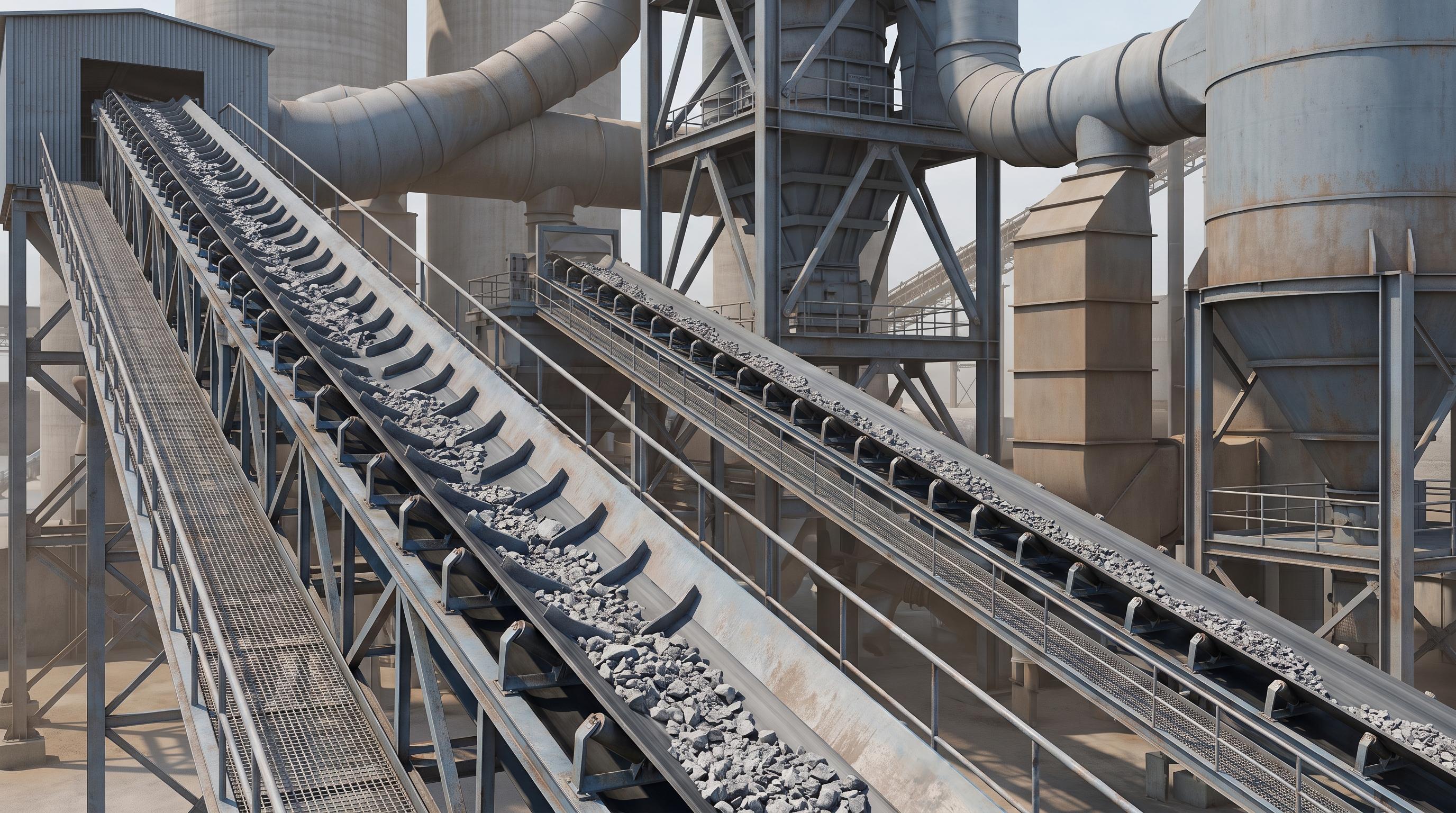
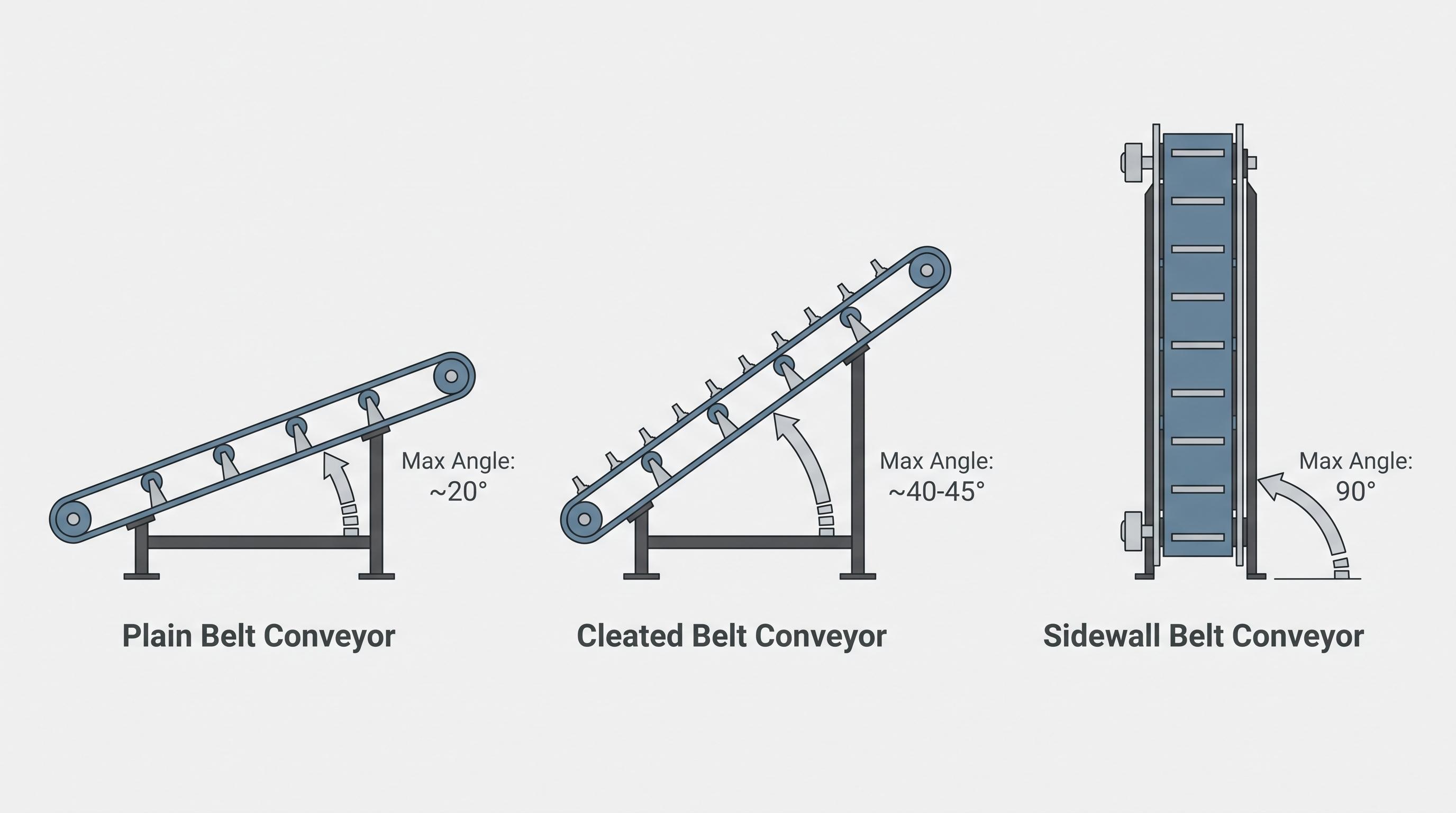
A belt conveyor's incline angle is the steepest slope it can climb before material slides back down. On a plain belt, most bulk material stops at about 20 degrees. Cleated belts get you to about 40. Sidewall belts can go straight up.
That number comes from your material. What counts is how well it grips the belt surface. The same design can run clean in one plant and slip in another.
Most projects set the incline from the building layout first. The material check comes later. Flipping that order takes one calculation.
This post covers how to find your limit, the numbers for common materials, and what to do when you need more angle.
Plain belts handle about 20 degrees for most bulk material. Cleated belts reach 40. Sidewall belts go to vertical. The formula everyone quotes, max angle = arctan(coefficient of friction), gives the static limit and runs about 10 degrees high on a real conveyor. Use published material values as your starting point and confirm by testing.
Plain belt conveyor incline angle: the practical working range
For most dry bulk material on a plain rubber belt, about 20 degrees.
CEMA puts the working range for most bulk solids at 10 to 20 degrees. Favorable materials with good grip reach 18 to 25 degrees. Below 15 degrees you are safe with almost anything. Above 20 you are into material-specific territory and need to check.
Three things stretch that ceiling:
Cleats on the belt surface give material something to sit behind. That gets you to roughly 40 to 45 degrees.
Corrugated sidewalls with cleats form pockets. Those run from 20 degrees all the way to 90.
Higher friction belt covers buy you a few degrees on a plain belt. They are not a fix for a steep layout.
Everything past 20 degrees costs money, adds parts, or both. The 20 degree line is where a plain belt stops being the cheap answer.
Why material slides back on a conveyor incline
Because gravity pulls material down the slope harder than friction holds it against the belt.
Every particle on an incline has two forces working on it. Gravity pulls it down the slope. Friction between the material and the belt cover holds it in place. Below a certain angle, friction wins and the load rides up. Past that angle, gravity wins and material starts moving backward relative to the belt.
You see material rolling down the belt face. The load arrives lighter than it left. Fines build up at the tail. The belt keeps running. The material just stops going with it.
Rounded particles roll before they slide, so they give up early. Washed gravel is the classic offender because every particle is a smooth sphere with nothing to catch on. Angular material like crushed stone interlocks with itself and with the belt cover, so it holds several degrees more.
How to calculate your maximum incline angle
Start with the friction relation, then cut it down. The first part is the one everyone publishes:
maximum angle = arctan(coefficient of friction)
The coefficient of friction is measured between your material and your belt cover. For typical bulk on a rubber belt it runs around 0.5 to 0.7.
Run those numbers and you get 27 to 35 degrees. That is roughly 10 degrees higher than any real conveyor will hold, and it is where most published guidance stops.
The formula describes a block sitting still on a fixed slope. A loaded conveyor is not that. Four things eat the difference:
Belt sag between idlers. The belt dips under load, so the local slope at the sag point is steeper than your design angle. CEMA guidance keeps sag to about 2 to 3 percent of the idler spacing for this reason.
Loading zone tumble. Material lands moving and takes several feet to settle. While it is tumbling it is not gripping.
Vibration. A running conveyor shakes. Shaking breaks static friction.
Starting and stopping. A loaded belt starting under full load sees forces the steady-state math never accounts for.
Put those together and the practical limit lands near 60 percent of what the formula says. Bituminous coal has a coefficient around 0.6, which gives 31 degrees on paper. The published working figure is about 18.
So use the formula to understand the mechanism, not to size the conveyor. For the number you actually build to, start from published material values and confirm by testing your material against your belt cover.
Belt conveyor incline angle by material
The number moves with what you are carrying. These are typical published starting points, not specifications:
Material | Typical max incline |
|---|---|
Gravel, washed and rounded | 10 to 12° |
Grain, whole | 15 to 16° |
Coal, anthracite | 16° |
Sand, dry | 16 to 20° |
Stone, crushed | 16 to 18° |
Coal, bituminous | 18° |
Cement | 20 to 23° |
Sand, damp | 20 to 24° |
Wood chips | 27° |
Read the two sand rows together, because they look backward. Damp sand climbs about 5 degrees higher than dry sand. A little surface moisture binds the particles to each other and to the belt. Go past damp to genuinely wet and it drops again, because now the water is lubricating instead of binding.
That is why material condition matters as much as material name. Moisture, fines, and surface texture can shift the working incline several degrees, so if you are comparing belt types or checking a real layout, the spec sheet pulls the key dimensions and component details into one place before you decide.
Grain shows the pattern clearly. When moisture changes, grip changes, and the safe incline changes with it. If your material condition swings through the year, test the condition you actually expect to convey instead of relying on a single handbook value.
Washed gravel at 10 to 12 degrees is the other row worth noticing. It is barely half of what crushed stone holds, for the same rock, because washing rounds the edges off.
Why angle of repose is not your incline limit
These two get mixed up constantly, and they are not interchangeable.
Angle of repose is the slope a pile forms when you dump material on the ground. It describes material against itself. Maximum incline angle describes material against your belt cover. Different surfaces, different physics, different numbers.
As a rough guide, the maximum incline usually lands somewhere near half the angle of repose. Coal has an angle of repose around 35 degrees and a working incline limit around 18. If you specify a conveyor at the repose angle, you have built something at roughly twice the slope your material will tolerate.
The useful version of the rule is that angle of repose tells you about stockpiles and hopper walls. For a conveyor, you need the friction between the material and the belt, and nothing else substitutes for it.
Cleated belt incline angle
Cleats work by giving material a wall to rest against instead of relying on friction alone. That changes the ceiling substantially.
Belt type | Incline range | What it costs you |
|---|---|---|
Plain belt | Up to ~20° | Nothing. Cheapest option. |
Cleated belt | Up to ~40 to 45° | No plows or scrapers. Harder to clean. Cleats wear. |
Corrugated sidewall | 20 to 90° | Highest cost. Specialty belt. Limited width and capacity. |
The tradeoff is real and worth understanding before you commit. Cleats block conventional belt cleaning, because a plow or scraper cannot ride across them. On sticky material that means carryback you now have to manage another way. Cleats also wear at the base and take the impact at loading.
Sidewall belts solve the angle problem completely and bring their own constraints. The belt is a specialty item with a longer lead time. Capacity per inch of width is lower. Replacements are not something you source locally.
A plain belt at 18 degrees usually beats a cleated belt at 35 if the layout gives you the horizontal room. Length is cheaper than complexity. If you are comparing those tradeoffs on a live project, check the cleaning requirement, maintenance burden, and available run before you choose.
How belt speed changes the incline limit
Speed does not change the friction, but it changes whether the material ever gets a grip.
The friction relation has no speed term in it. In practice, running fast on an incline hurts you in two places. Material lands on the belt with more energy at the loading point, so it tumbles longer before it settles. And a faster belt sags and recovers more between idlers, which keeps disturbing the load.
The usual answer on a steep incline is to slow down. Our belt conveyors run VFD controlled from about 100 to 790 feet per minute. Steep inclines sit toward the lower half of that range. You give up some capacity per foot of belt and get it back in belt width.
Idler spacing works the same way. Closer idlers mean less sag, which means the local slope stays closer to your design angle instead of dipping past it. On an incline running near its limit, tightening the carrying idler spacing is often the cheapest fix available.
When a belt conveyor is the wrong tool
Past about 30 degrees, you are asking a belt to do something another machine does better. If the real problem is carryback, spillage, or poor flow rather than angle alone, fix that root cause before forcing a belt into the wrong duty.
The alternatives:
Bucket elevator. Vertical, compact footprint, and the right answer for lifting material straight up.
Screw conveyor. Handles incline well up to a point, with capacity falling off as the angle climbs.
Pneumatic conveying. Goes anywhere a pipe goes. Costs more to run and is hard on friable material.
More horizontal run. Sometimes the cheapest fix is a longer, shallower conveyor.
The last one gets dismissed too quickly. A conveyor at 15 degrees is a conveyor that works. Extra length is steel and idlers, which are the cheap parts. A cleated belt at 40 degrees to save 60 feet of run is a decision worth checking twice.
The layout usually sets the angle
Most of the incline questions we get asked come after the layout is fixed. The building sets the geometry, the conveyor has to bridge two points, and the angle falls out of the drawing. That same issue shows up across cement, mining, and other bulk-handling duties.
That is backwards, and it is one calculation to fix. Find your material's limit first, then place the conveyor.
We build to CEMA guidelines, and the incline is one of the few numbers where the material decides and the equipment follows. If you have a fixed rise and a material you are not sure about, our engineers can check it for you. They will tell you whether a plain belt holds your angle, or whether you need cleats.
Key takeaways
Plain belts carry most bulk material to about 20 degrees. Cleated belts reach 40. Sidewall belts go vertical.
The arctan formula gives the static limit and runs about 10 degrees high. Belt sag, loading tumble, and vibration account for the gap.
Damp sand climbs about 5 degrees higher than dry sand. Rounded material like washed gravel gives up earliest, at 10 to 12 degrees.
Angle of repose is roughly double your incline limit. It describes stockpiles, not belts.
A longer conveyor at 15 degrees usually beats a cleated belt at 35 when you have the room.
Frequently asked questions
About 20 degrees for most dry bulk material on a plain rubber belt. CEMA puts the working range for most bulk solids at 10 to 20 degrees. Cleated belts reach roughly 40 to 45 degrees, and corrugated sidewall belts run from 20 degrees to vertical. The exact number depends on the friction between your material and your belt cover.
The relation is maximum angle = arctan(coefficient of friction), measured between your material and your belt cover. For typical bulk on rubber that gives 27 to 35 degrees. Real conveyors hold about 60 percent of that, because belt sag, loading zone tumble, vibration, and starting under load all break static friction. Use the formula to understand the mechanism, and published material values plus testing to size the conveyor.
Because gravity is pulling material down the slope harder than friction is holding it to the belt. Rounded particles roll before they slide, so washed gravel gives up around 10 to 12 degrees while angular crushed stone interlocks and holds 16 to 18. You see it as material rolling down the belt face, a lighter load at discharge, and fines collecting at the tail.
Roughly 40 to 45 degrees. Cleats give material a wall to rest against rather than relying on friction alone. The tradeoff is that plows and scrapers cannot ride across cleats, so belt cleaning gets harder, and the cleats themselves wear at the base and take the impact at loading.
No, and confusing them is expensive. Angle of repose is the slope a pile forms on the ground, which is material against itself. Maximum incline is material against your belt cover. The incline limit usually lands near half the repose angle. Coal has a repose angle near 35 degrees and a working incline limit near 18.
Not in the friction math, but yes in practice. A faster belt means material lands with more energy and tumbles longer before it grips, and the belt sags and recovers more between idlers. Slowing down and tightening the carrying idler spacing are both standard fixes on an incline running near its limit.
Check whether extra horizontal run is possible first, since a longer conveyor at 15 degrees is cheaper and simpler than a cleated belt at 40. If the angle is fixed, cleats get you to about 45 and sidewall belts go to vertical. Past 30 degrees a bucket elevator is often the better machine, and pneumatic conveying is an option where a pipe can go.