
Dust Control
Choosing Between Cyclone and Bag Filter Systems: What Plant Teams Should Evaluate First

Vijay Baid
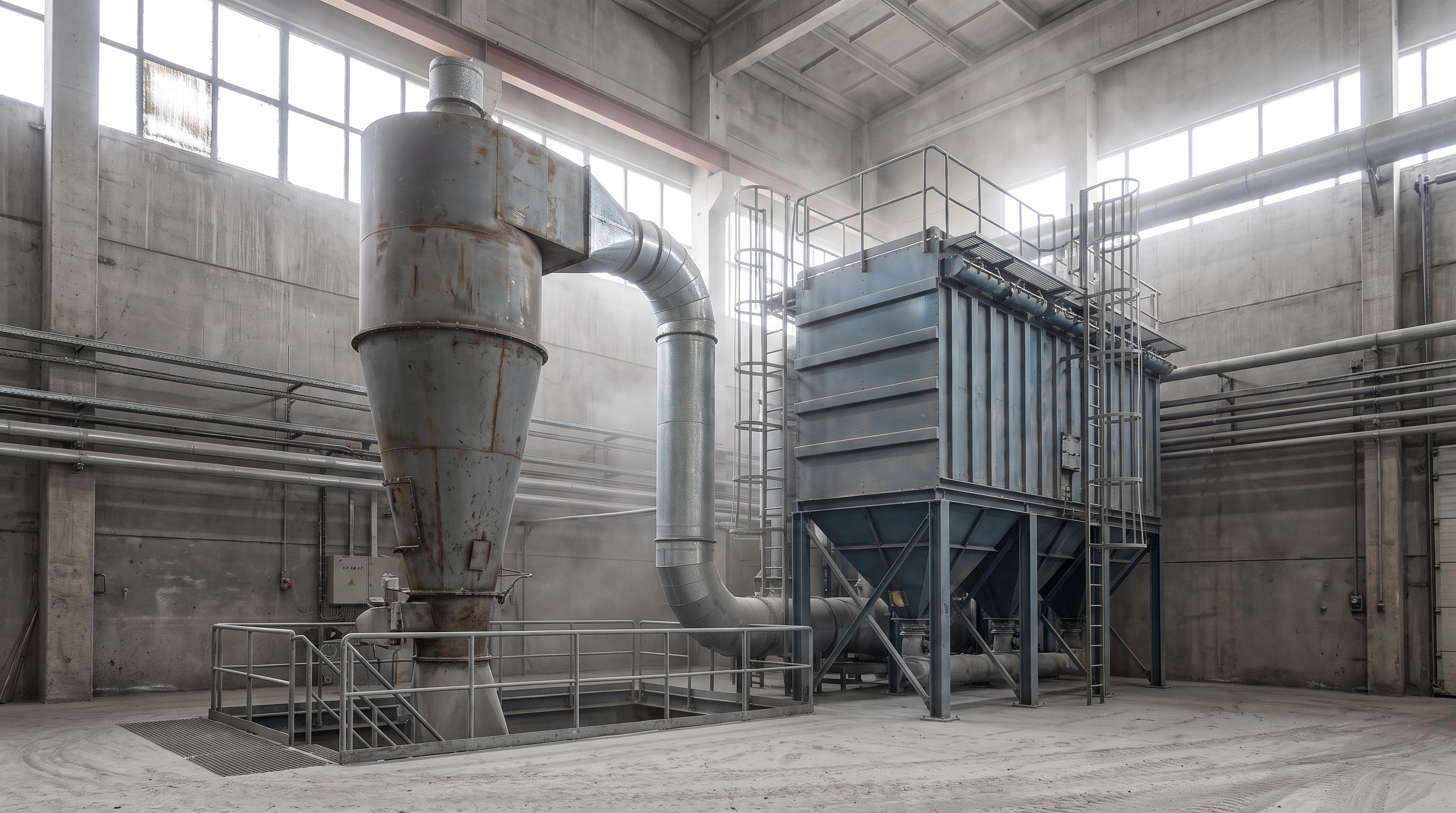
Choose a cyclone when the dust is coarse, hot, or abrasive and you want a rugged, low-maintenance first stage. Choose a bag filter when the dust is fine and emissions limits are strict. Use both when you need to protect filter media and still hit a cleaner outlet. The right choice depends on particle size, gas conditions, outlet targets, and total operating cost.
In industries like cement, mining, wood processing, chemicals, and food, dust collection is more than a compliance need. It also protects process efficiency, worker safety, and equipment life.
When plant teams design a dust collection system, they often need to choose between a cyclone and a bag filter. The wrong choice can cause fast downtime. A baghouse handling coarse, abrasive dust can wear out bags in weeks. A cyclone handling ultra-fine powder may miss emissions targets and fail checks under rules such as those from the US Environmental Protection Agency (EPA).
This guide walks through the technical criteria plant teams must evaluate first, compares the mechanical realities of both systems, and outlines when a hybrid approach is the smartest path forward.
The 5 Core Evaluation Factors for Plant Teams
1. Particle Size Distribution and Material Properties
The physical profile of your bulk material determines whether inertia alone can separate dust from the air stream or if fabric barrier filtration is required.
Cyclone Separators: Operate using centrifugal force and material inertia. They achieve high collection efficiency on heavy, coarse particles (>10 μm) such as sawdust, grain hulls, clinker, or plastic regrind. However, their efficiency drops sharply on fine powders (<5 μm).
Bag Filter Systems: Rely on surface and depth filtration using fabric media. They capture ultra-fine particulates down to 0.1 μm at efficiencies exceeding 99.9%.
Sticky & Hygroscopic Dust: Cyclones have no filter media to blind, making them resilient against moisture fluctuations. In contrast, sticky dust in a bag filter blinds the media, spikes differential pressure, and causes premature bag failure.
2. Environmental Compliance & Outlet Emissions Limits
Your local air quality management district or national emissions limits often dictate equipment selection automatically:
Cyclones Alone: Typically achieve 80%–90% overall mass efficiency. They rarely meet modern ambient air discharge standards (<10 mg/Nm³) when processing fine powders.
Baghouse Filters: Built to satisfy stringent environmental standards, such as those set by OSHA for workplace exposure limits and industrial ventilation guidelines.
When dust leaves a cyclone or baghouse, the hopper must keep a good pressure seal. If it does not, air leaks can upset the system and reduce performance.
Evaluating system pressure drops, air-to-cloth ratios, or gas stream dew points? This spec sheet gives you a quick technical reference before you size or replace your air filtration equipment.
3. Gas Stream Temperature and Moisture Profiles
Operating conditions upstream determine whether sensitive filter media can survive without degrading.
High Temperatures (>250°C): Cyclones are fabricated from carbon steel, stainless steel, or ceramic-lined alloys, allowing them to operate at temperatures exceeding 500°C. Bag filters require specialized high-temperature media such as P84, PTFE, or fiberglass, which significantly increase capital expenditure.
Moisture & Acid Dew Point: If flue gas drops below its dew point inside a baghouse, moisture combines with dust to form a hard crust ("mud-plugging"). Cyclones handle near-dew-point conditions with much lower risk of operational failure.
Sparks and Embers: Cyclones act as natural spark arrestors by dropping hot embers into the hopper before they reach downstream equipment.
4. Differential Pressure and Energy Consumption
Static pressure drop across the collector directly impacts fan motor horsepower and monthly utility costs:
Cyclones: Maintain a constant, predictable pressure drop (typically 750–1,500 Pa). Fan energy draw remains steady regardless of operational hours.
Baghouse Filters: Operate at a variable pressure drop (1,000–2,000 Pa). As dust builds up between pulse-jet cleaning cycles, differential pressure rises, increasing fan energy consumption and requiring compressed air for cleaning.
5. Footprint, Maintenance, and Capital Investment
Capital Expenditure (CAPEX): Cyclones feature simple, static construction with no moving internal parts, making initial procurement costs significantly lower. Baghouse systems require pulse-jet valves, blowpipes, filter cages, and control panels.
Operational Maintenance (OPEX): Cyclones require minimal routine maintenance beyond checking for wall wear in abrasive applications. Baghouses require continuous differential pressure monitoring, pulse-jet solenoid valve servicing, and periodic filter bag changeouts.
Handling discharged particulate from either collector requires reliable material handling equipment. Ensure your hoppers integrate smoothly with an enclosed Screw Conveyor, a precise Rotary Airlock Valve to maintain pressure differentials, or a dust-tight Airslide Assembly for fine powders.
Unsure whether a cyclone, bag filter, or multi-stage system is right for your process layout? Our application engineers can evaluate your gas stream parameters and material characteristics.
From the Field: A biomass power plant had severe bag blinding in its pulse-jet baghouse on a wood-waste flue gas line. The gas stream carried coarse sand, hot embers, and fine fly ash straight into the baghouse. The coarse material wore down the lower part of the bags. The embers burned small holes in the polyester media. The plant had to replace all 480 bags every 8 to 12 weeks, which led to heavy downtime and replacement cost. The fix was to install a high-efficiency cyclone before the baghouse. It removed more than 85% of the coarse sand and kept hot embers out of the filter house. The team also switched to woven aramid bags for the remaining fine ash. After the change, bag life went from 2 months to more than 18 months. Pulse-cleaning air use dropped by 45%, and fan load became more stable.
The Hybrid Approach: Two-Stage Filtration Circuits
In high-volume bulk solids handling, choosing either a cyclone or a bag filter is often a false choice. The most reliable engineering strategy is frequently a two-stage hybrid system:
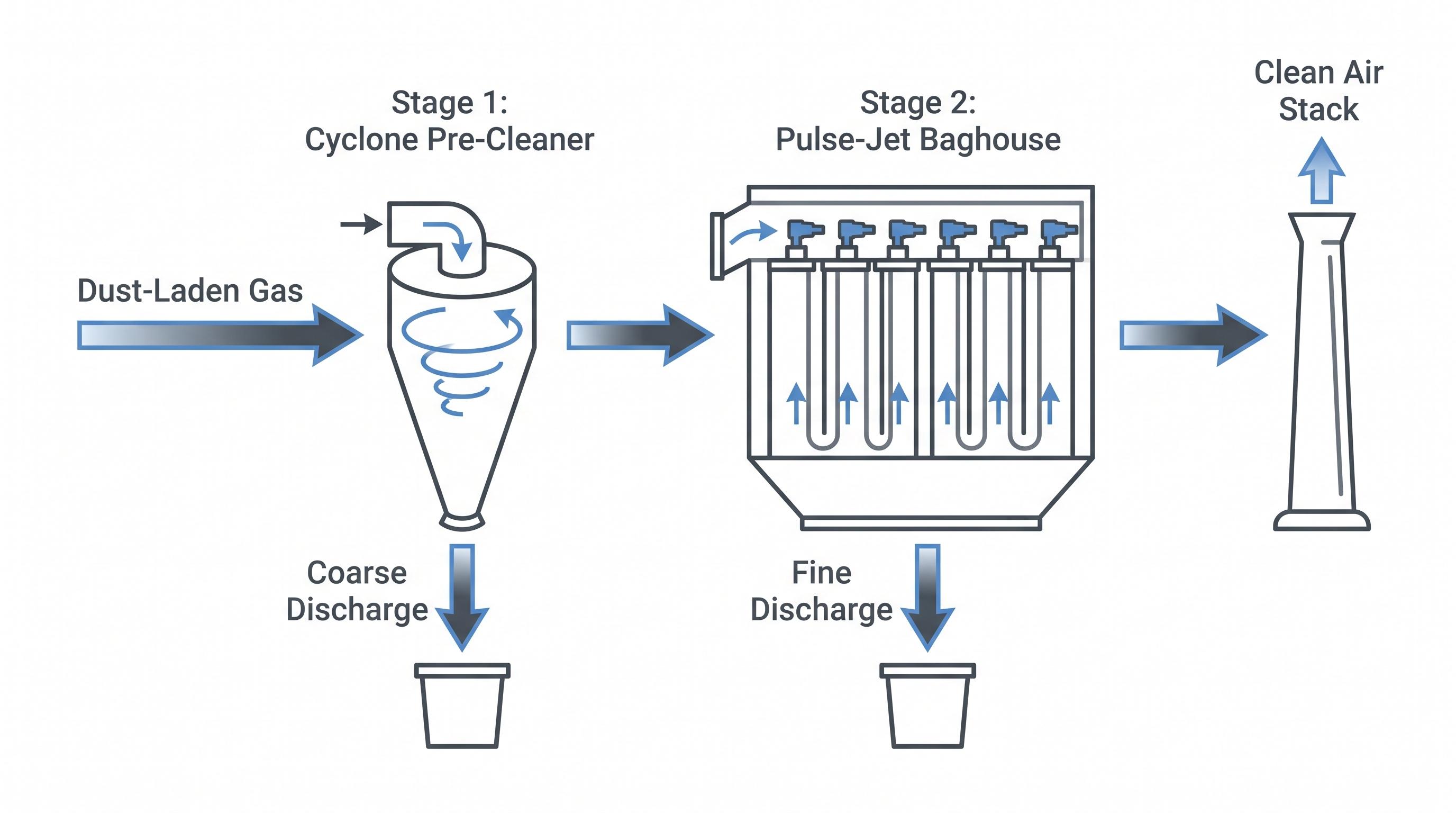
First Stage (Cyclone Pre-Cleaner): Knocks down 80%–90% of coarse, abrasive material and spark embers, protecting downstream filter media.
Second Stage (Bag Filter): Captures remaining sub-micron fines to ensure full compliance with regional emission standards.
Final Key Takeaways
Choosing between a cyclone and a bag filter means balancing upfront cost with long-term reliability. Cyclones are a strong fit for coarse dust, high temperatures, and abrasive duty. Bag filters are better when you need very high capture efficiency for fine dust. If you review particle size, dew point, and operating cost early, you can choose a system that gives cleaner air, lower maintenance, and longer service life. In many plants, a two-stage system is the best answer.
Frequently Asked Questions (FAQ)
A cyclone is often the right choice when the dust is coarse, abrasive, or hot, and when the system needs a rugged collector with low maintenance. It is also a strong fit as a pre-cleaning stage ahead of a baghouse in bulk solids and high-temperature process lines.
A bag filter is usually the better choice when the process produces fine particulates, when emissions limits are strict, or when very high capture efficiency is required. It is especially effective where outlet dust concentration must stay consistently low across changing operating conditions.
Yes. In many industrial applications, a cyclone works well as a first-stage pre-cleaner that removes coarse and abrasive particles before the gas stream reaches a baghouse. This reduces bag wear, improves reliability, and helps the final stage meet tighter outlet cleanliness requirements.
Start with particle size distribution, dust loading, gas temperature, moisture levels, and the outlet emissions target. You should also review available footprint, maintenance access, and how collected material will discharge into the downstream handling system.