
Conveyor Pulley Lagging Types: Rubber vs Ceramic vs Diamond — Complete Selection Guide

Vijay Baid
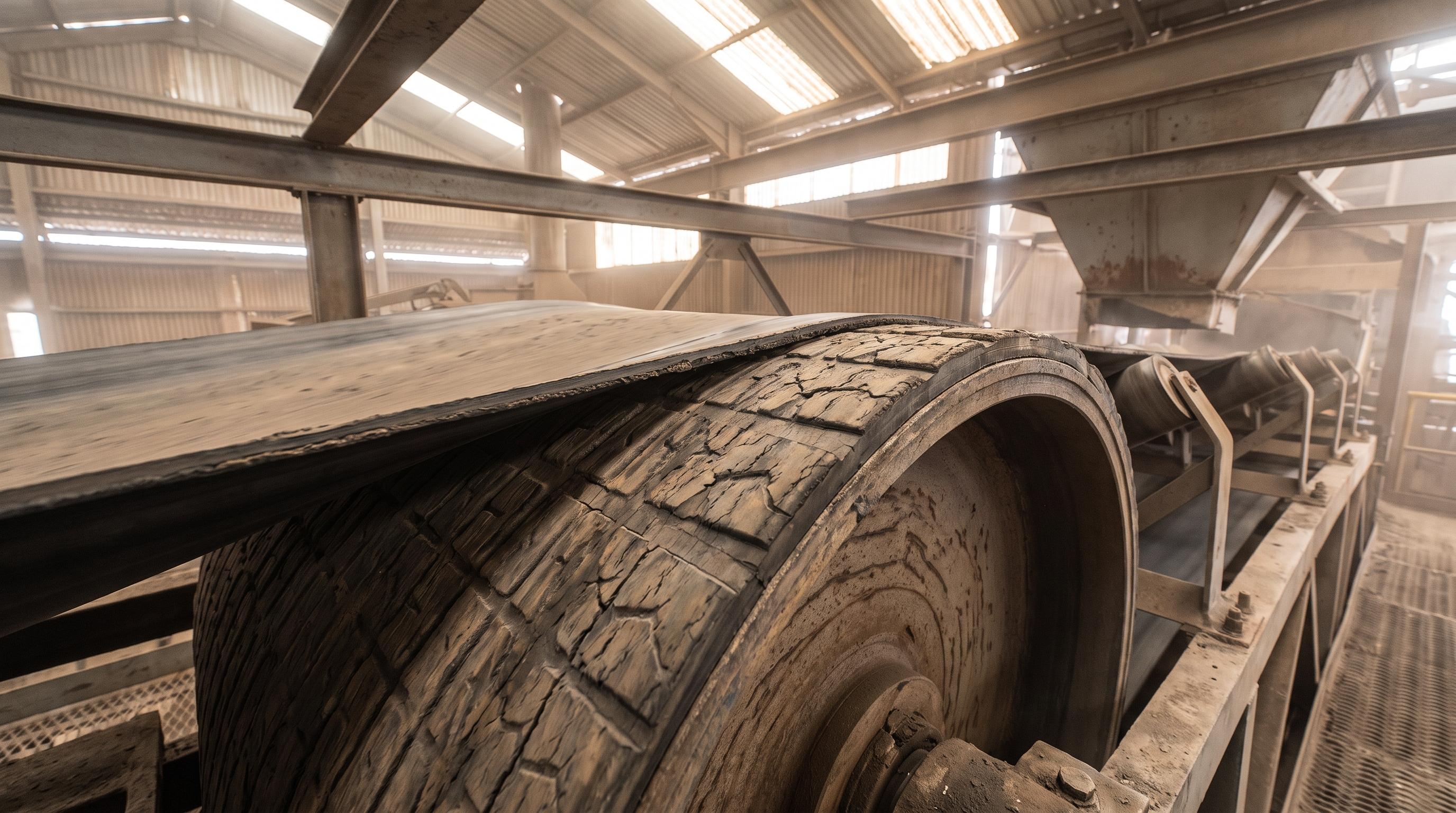
Use plain rubber lagging on clean, non-drive pulleys, diamond groove rubber on general-purpose and reversible drives, herringbone on one-direction drives only when installed in the correct direction, and dimpled ceramic on wet, high-tension, abrasive duty where slip risk is highest. The wrong lagging choice reduces traction, builds heat, increases wear, and often leads operators to over-tighten take-up tension, which then shifts the failure into bearings, shafts, and belt life.
When a primary belt conveyor slips under load, costs rise fast. In cement plants, coal yards, and mining reclaim systems, lost drive traction does more than stop the belt. It creates friction heat, scorches the bottom cover, speeds up wear, and disrupts downstream feed units.
At the center of drive power transmission lies pulley lagging: the specialized material bonded directly to the external steel shell of a conveyor drum.
Plant teams often treat lagging as a standard purchase item. That is risky. The right material and surface pattern help prevent slip, shed moisture, reduce shell wear, and extend belt life.
This guide compares the main pulley lagging types. It covers friction, wear, and where each option works best. The focus is plain rubber, diamond groove rubber, herringbone, and ceramic lagging.
The Engineering Role of Pulley Lagging
Pulley lagging serves two primary mechanical functions in a belt conveyor system:
Maximizing Drive Friction: It raises the coefficient of friction (μ) between the pulley shell and the conveyor belt's bottom cover, allowing higher drive torque transmission without belt slippage.
Protecting Structural Components: It acts as a sacrificial wear layer that shields the steel pulley shell from abrasive wear and prevents foreign material from embedding directly into the belt carcass.
The fundamental relationship governing drive traction is defined by the Euler-Eytelwein equation:
T1 / T2 ≤ eμθ
Where:
T₁ = Tight-side belt tension (N)
T₂ = Slack-side belt tension (N)
μ = Coefficient of friction between lagging and belt bottom cover
θ = Wrap angle around the drive pulley (radians)
When operating in wet, muddy, or dusty conditions, unlagged steel drums (μ ≈ 0.15–0.20) frequently experience drive slippage (T₁ / T₂ > e^(μθ)). Upgrading to grooved rubber or high-traction ceramic lagging raises the friction coefficient up to 0.70, allowing the drive drum to handle heavy motor torque without requiring excessive slack-side tension (T₂).
For traction calculations and belt sizing, engineering teams usually check DIN 22101 and CEMA belt conveyor guidance first. These references help confirm pulley selection, wrap assumptions, and take-up settings before final design.
Technical Comparison : Lagging Types & Properties
Technical Parameter | Plain Sheet Rubber | Diamond Groove Rubber | Herringbone Groove Rubber | Dimpled Ceramic Lagging | Smooth Ceramic Lagging |
Coefficient of Friction (μ) - Dry | 0.35–0.40 | 0.40–0.45 | 0.40–0.45 | 0.55–0.75 | 0.50–0.60 |
Coefficient of Friction (μ) - Wet | 0.15–0.20 | 0.30–0.35 | 0.30–0.35 | 0.50–0.65 | 0.35–0.45 |
Typical Thickness Spectrum | 8–12 mm | 10–15 mm | 10–15 mm | 12–20 mm | 12–20 mm |
Relative Wear Resistance | Baseline (1×) | Good (1.5×) | Good (1.5×) | Exceptional (3×–5×) | Excellent (3×–4×) |
Primary Drum Application | Tail, Bend, Take-Up | Primary/Secondary Drive | Single-Direction Incline Drive | Heavy High-Tension Drive | Non-Drive / High-Abrasive |
De-watering Capability | Poor | Excellent (Multi-directional) | Good (Directional) | Outstanding (Self-clearing) | Moderate |
Directional Sensitivity | Non-directional | Non-directional | Directional (Apex points with belt) | Non-directional | Non-directional |
Need the key lagging options, application ranges, and selection checkpoints in one quick reference? Download the spec sheet for a faster engineering review.
Deep Dive: Evaluating Lagging Types
1. Plain Rubber Lagging
Plain rubber lagging is a smooth layer of natural or synthetic rubber. It is usually about 65 Shore A hardness. It is bonded or vulcanized to the steel shell.
Best Used For: Non-drive pulleys, such as tail terminals, snub rollers, bend drums, and gravity take-up pulleys operating in dry, clean conditions.
Limitations: Plain rubber provides poor water-shedding performance. In wet environments, a thin film of water creates a hydroplaning effect between the belt and pulley face, causing friction levels to plummet to near bare-steel values (μ ≤ 0.20). It should never be specified for primary drive drums in outdoor or washdown zones.
2. Diamond Groove Rubber Lagging
Diamond groove lagging uses a rubber surface with molded or cut grooves. These grooves create small pads that flex under belt pressure and improve contact.
Mechanical Action: The diamond grooves act as drainage channels, squeezing out water, slurry, and fine dust particles away from the contact zone as the belt wraps around the drum.
Key Advantage: Because the pattern is non-directional, diamond lagging functions identically whether the conveyor runs in forward or reverse. This makes it the standard specification for reversible drive conveyors, tripper cars, and shuttle systems.
3. Herringbone Groove Rubber Lagging
Herringbone lagging uses V-shaped grooves cut into the rubber. The pattern forms a chevron that points toward the center of the drum.
Mechanical Action: The chevron design channels water and debris outward from the center toward the pulley edges as the drum rotates.
Installation Warning: Herringbone lagging is directionally sensitive. The apex (point) of the V-pattern must point in the direction of belt travel. Installing herringbone lagging in reverse will trap water and slurry at the center of the drum, accelerating belt slip and localized rubber tearing.
4. Ceramic Tile Lagging (Dimpled vs. Smooth)
Ceramic lagging uses high-purity aluminum oxide (Al₂O₃) tiles, usually 92%–95% pure, set in a flexible rubber backing. The rubber layer absorbs impact. The exposed tiles contact the belt bottom cover and resist wear.
Dimpled Ceramic Lagging: Features raised cylindrical dimples on each tile. Under high belt tension, these dimples press into the bottom cover rubber, creating a mechanical interlock that produces high friction (μ ≥ 0.70). It is the industry standard for high-tension drives (>80 kN), long overland conveyors, and wet/slurry applications.
Smooth Ceramic Lagging: Utilizes flat, smooth-faced ceramic tiles. It provides high abrasion resistance without penetrating the belt cover, making it ideal for non-drive pulleys (such as bend or snub drums) exposed to severe carryback wear.
Application-Specific Selection Framework
To improve service life, choose lagging for the actual duty. Look at moisture, dust, load, belt tension, and the type of material in the system.
Cement Plants (Clinker, Limestone, Raw Meal)
Drive Drums: Specify dimpled ceramic lagging (15–20 mm) for raw meal feed and clinker transport conveyors. Clinker dust acts as a severe abrasive; rubber lagging wears down rapidly, leading to frequent drum replacements.
Non-Drive Drums: Use smooth ceramic or heavy-duty diamond rubber (12 mm) to resist abrasive dust grinding between the belt and tail/snub drums.
Steel Mills & Ore Handling (Iron Ore, Sinter, Coal Fines)
Primary Slurry/Ore Incline Drives: Install dimpled ceramic lagging with a cold-bonding CN (canvas-backed) layer. High material density and water spray require maximum friction coefficients to prevent runaway belt slip.
Tail & Reclaim Pulleys: Combine winged self-cleaning tail drums with plain rubber on internal slats or smooth ceramic on continuous shells to handle sticky iron ore concentrate.
Thermal Power Plants (Coal Yards & Fly Ash Handling)
Main Coal Feed Drives: Specify diamond groove rubber (12–15 mm, 60 Shore A) for indoor runs and dimpled ceramic for long outdoor overland conveyors.
Reversible Shuttle Drives: Always specify diamond groove rubber over herringbone to maintain equal de-watering capabilities in both travel directions.
Common Procurement & Installation Mistakes
Check material and bonding specs against ISO 4649 for abrasion and ASTM D429 for rubber-to-metal adhesion. Also review OSHA machine guarding guidance before work around rotating conveyor equipment.
Cold-Bonding Ceramic on High-Shear Drives Without Primer: Applying cold-bonding adhesives directly to un-sandblasted steel or skipping the metal primer coat leads to inter-facial bond failure. Under high startup torque, the entire lagging strip can shear off the drum shell.
Incorrect Rubber Hardness Selection: Specifying overly hard rubber (>75 Shore A) reduces the real contact area against the belt cover, lowering overall traction. Conversely, using soft rubber (<50 Shore A) on high-tension drives causes excessive shear deformation, causing the grooves to tear at the edges.
Ignoring Pulley Shell Thickness Before Ceramic Retrofitting: Ceramic tiles create localized point loads on the pulley shell. Applying dimpled ceramic lagging to an under-specified, thin-walled drum (<8 mm) can flex the shell, cracking the ceramic tile bonding matrix and breaking the internal welds.
Reversing Herringbone Alignment: Installing V-patterned herringbone lagging with the point facing backwards turns the grooves into collection pockets that trap slurry, accelerating wear and lowering traction.
If your plant is facing slip, fast lagging wear, or uncertainty about pulley selection, our engineers can review the duty. They can recommend the right configuration for your conveyor.
From the Field: A limestone facility faced severe drive slippage on an outdoor 1,200 mm incline belt during the monsoon. The 1,000 mm drive pulley had 10 mm plain rubber lagging. Rainwater mixed with fine limestone dust and formed a slick slurry on the drum face. Operators increased the take-up counterweight to raise slack-side tension (T₂). That stopped the slip for a short time, but it bent the snub pulley shaft and damaged the drive bearings within three months. We fixed the root cause by fitting dimpled ceramic lagging with a cold-bonded CN backing layer and resetting the counterweight to its design level. Friction rose from μ ≈ 0.20 to μ ≥ 0.60. Slippage stopped, bearing temperature dropped by 14°C, and the drive ran through three monsoons without unscheduled maintenance.
Final Takeaway
Good conveyor performance depends on more than drum size. You need lagging that matches your duty. Use smooth rubber for low-tension non-drive pulleys. Use diamond or herringbone for general drive duty. Use dimpled ceramic for wet, high-tension, or severe service.
Your lagging choice should also fit the rest of the material handling system. That includes Conveyor Idlers, Belt Conveyors, Screw Conveyors, and control gates such as Diverter Valves. When these parts work together, you reduce wear and protect plant throughput.
Frequently Asked Questions (FAQ)
Hot-vulcanized lagging is applied in an autoclave under high heat and pressure, bonding the rubber seamlessly to the steel shell with high bond strength. Cold-bonded lagging uses specialized chemical cements to attach pre-vulcanized rubber or ceramic sheets directly to the pulley in the workshop or field. Hot-vulcanization is preferred for extreme-duty manufacturing, while cold-bonding allows fast, on-site repairs without removing the pulley shaft.
When properly specified, dimpled ceramic lagging does not damage high-grade conveyor belts. The dimples are engineered with rounded top edges that press gently into the rubber cover without tearing the fabric or steel cord carcass. However, if a drive pulley experiences prolonged spinning due to a complete mechanical jam, dimpled ceramic can wear down the bottom cover faster than rubber lagging.
Lagging should be scheduled for replacement when:
Grooves on rubber lagging wear down below 2 mm depth, eliminating de-watering channels.
Ceramic tiles are missing, cracked, or worn smooth across more than 15% of the pulley face.
De-lamination or edge lifting occurs along the bonding seam.
Drive slippage occurs under normal operating loads and correct take-up tensions.
Yes. The symmetrical diamond grid provides equal water-channeling capability in both forward and reverse directions, making it the top choice for reversible conveyors, shuttle systems, and tripper cars.