
Garland Idlers: When to Use Them on Long-Span and Heavy-Duty Conveyor Runs

Vijay Baid
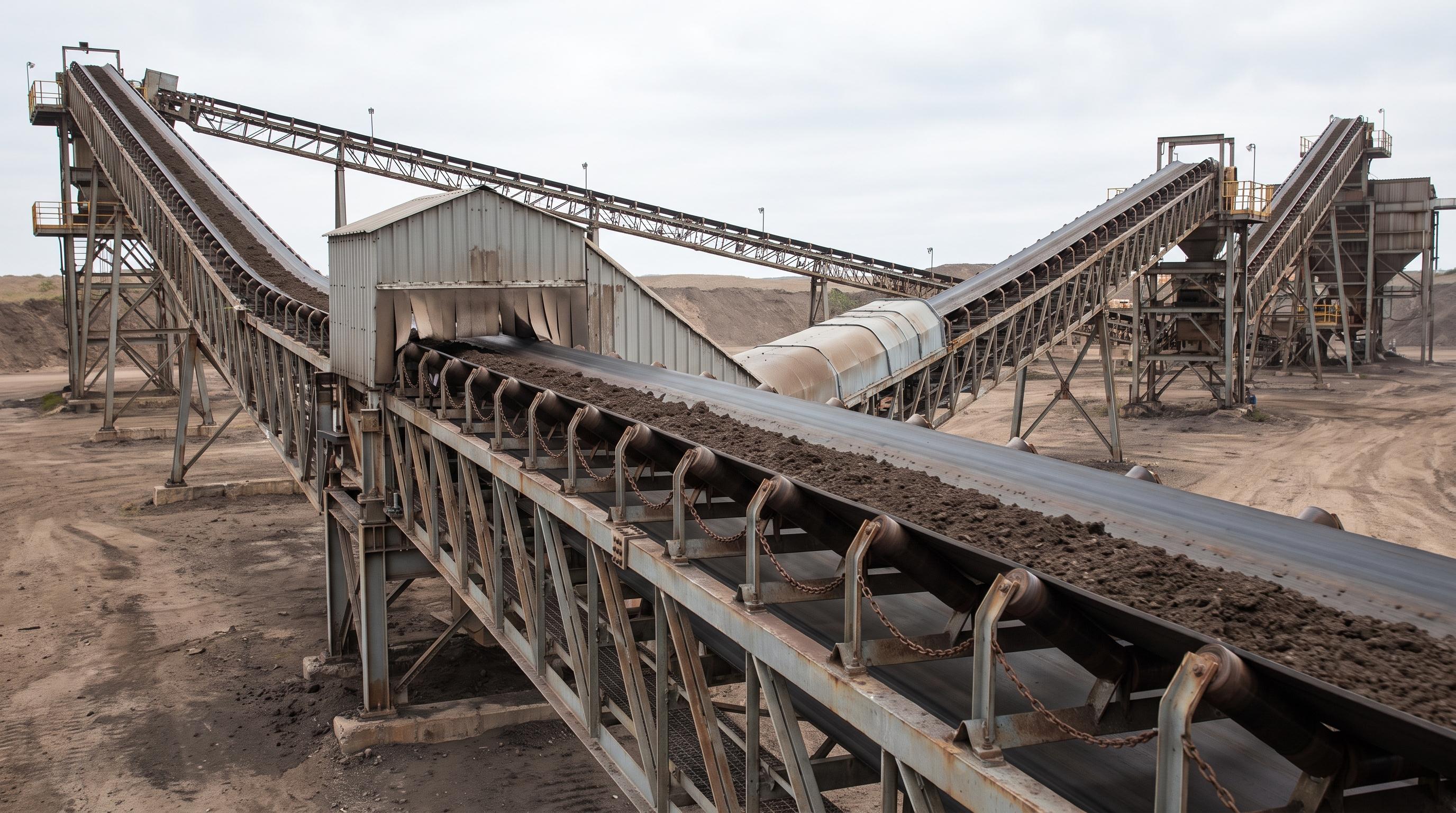
If your conveyor runs with high impact, long spans, or repeated mistracking, garland idlers are often the better choice. They reduce shock loading, improve belt tracking, speed up change-outs, and cut downtime in heavy-duty service. For plant teams making a specification or retrofit decision, the value is clear: lower maintenance cost, longer component life, and more reliable operation.
In heavy-duty conveying, the cost of using the wrong idler design shows up fast. Frames bend, bearings fail, belts wear at the edges, and spillage adds cleanup and downtime. For plants handling long spans, high impact, or unstable alignment, this is not a minor maintenance issue. It is a reliability and cost problem that often justifies a better support system.
If your conveyor sees repeated impact, mistracking, or difficult maintenance access, the real question is not whether the problem exists. The real question is whether rigid frames are still the right choice for the duty.
This is where garland idlers make the strongest case. They are not just a different support method. They are often a better fit for conveyors that need higher uptime, safer maintenance, and more stable belt behavior under real plant conditions.
The Challenge of Long-Span & Heavy-Duty Conveying
Overland conveyors and high-capacity mining systems face heavy dynamic loads every day. Rigid-frame idlers were not built to handle that stress for long periods. The problem grows as belts get wider, speeds rise above 5.0 m/s, and capacities climb into the thousands of metric tons per hour. In those conditions, the limits of fixed-frame idlers become clear and expensive.
When dense ore or rock drops from several meters above the belt, the force travels straight through rigid steel frames into the support structure. That leads to bent frames, early bearing failure, shell damage, and faster belt wear. Long overland conveyors face another problem. Uneven ground, thermal movement, and light support structures make it hard to keep fixed idlers aligned. Even small alignment errors can turn into belt mistracking, edge wear, and material spillage.
Garland idlers solve these problems by replacing rigid supports with flexible roller assemblies linked by chains or elastomeric joints. The full set moves with the belt instead of resisting it. This helps absorb impact, handle off-center loading, and cope with structural movement. The next sections explain how garland idlers differ from rigid frames, where they work best, and how to use them in high-capacity bulk handling systems.
Rigid vs. Garland Idlers: Core Mechanical Differences
The fundamental distinction lies in how each design responds to force.
Performance Parameter | Rigid Frame Idlers | Garland (Catenary) Idlers |
|---|---|---|
Mounting Style | Welded or bolted rigid steel base frame | Suspended via quick-release hooks, chain links, or flexible joints |
Shock Absorption | Transfers kinetic impact directly into structure and bearings | Swings dynamically to dissipate impact energy over time and distance |
Material Centering | Static geometry; off-center loads cause progressive belt wander | Dynamic; shifts under asymmetrical load to re-center the belt naturally |
Maintenance Access | Requires belt lifting, jacking, and unbolting under tension | Quick-hook or pin release allows complete set exchange in minutes |
Terrain & Structural Flexibility | Demands precise, continuous leveling of stringers | Tolerates settlement, thermal movement, and minor structural deflection |
Typical Service Life under Heavy Impact | Often limited by frame fatigue and bearing shock loading | Significantly extended by reduced peak loads on rollers and structure |
The rollers in a garland set are linked instead of fixed in place. That makes the assembly act like a flexible chain. Under load, it forms a natural catenary curve that follows the belt profile more closely. This reduces local pressure points. It also spreads the load more evenly across the full belt width.
When to Use Garland Idlers: Key Evaluation Criteria
1. High-Impact Loading Zones
Rigid impact idlers often fail at primary crusher discharge points, apron feeder transfers, and other loading zones with large lump size and high drop height. The risk is highest when material larger than 200 mm falls more than 1.5–2 meters. The sudden drop creates peak forces that crack frames and damage bearings. Garland impact idlers with heavy rubber discs or thick polyurethane rings flex under load. That turns a sharp hit into a lower force spread over more time. It helps protect both the belt carcass and the roller bearings. In many plants, the first 8–15 meters of the loading zone are the best place to install them. Purpose-built garland idlers for mining applications are designed for this duty.
2. Long-Span Overland Conveyor Runs
Long overland conveyors often cross uneven ground, river crossings, and areas that shift with the seasons. That creates constant alignment problems. Rigid frames need frequent re-leveling and still tend to distort over time. Garland idlers hang from support ropes or light steel channels and can move on their own. This lets them follow structural movement without binding. It helps keep the belt centered and lowers fatigue in both the belt and the support structure.
Evaluating troughing angles, impact energy absorption, or replacement roll dimensions for a new or retrofit project? Access engineering baseline parameters for garland and rigid idler selection.
3. Self-Aligning and Centering Requirements
Off-center loading is one of the main causes of belt mistracking and edge damage. A garland idler hangs freely from two upper attachment points. When the load shifts to one side, that side drops and moves forward. This changes the trough shape for a short time. The change creates a corrective force that guides the belt back toward the centerline. The effect is gentler on belt edges than guide rollers or aggressive training idlers. In plants where loading is not always even, this can reduce spillage and edge wear.
4. High Belt Speeds and Variable Troughing Needs
Transition zones become more important when belt speed rises above 4.0 m/s. Garland idlers can be arranged in 3-roll or 5-roll sets with deep troughing angles, usually from 35° to 45°. Five-roll sets create a smoother and more rounded cross-section. That reduces sharp flexing at belt transition points. The larger cross-section can also carry more material without increasing belt speed or width. The flexible suspension helps the belt stay stable at higher speeds.
5. Rapid Maintenance and Reduced Downtime Requirements
On long overland systems with thousands of idler sets, even one roller change can take too much time. Rigid frames usually force crews to stop the belt, lift it with jacks, and remove hardware under tension. In the field, that can take 30–60 minutes for each set. Garland idlers use quick-release hooks or pins. Crews lift the belt slightly, remove the full assembly, and fit a prepared replacement set, often in under ten minutes. That saves time and supports safer maintenance practice.
If you are deciding between staying with rigid frames and moving to garland suspensions, review the numbers that matter most: impact level, failure rate, change-out time, and downtime cost. Our engineering team can assess your duty conditions and recommend the right roll count, troughing angle, and support layout for a retrofit or a new conveyor line.
From the Field: A coastal bauxite terminal ran a 2200 mm overland conveyor at 4.8 m/s with a design capacity of 6,000 MTPH. The loading zone handled 250 mm boulders falling about 3.5 meters. In this area, rigid 45° impact idler frames cracked at the welds every three to four weeks.
Root Cause Analysis: The rigid base plates and side frames had almost no give. Each impact sent a high force straight into the welds and roller shafts. Over time, that caused fatigue cracks in the frames and oval wear in the center rollers. Bearing life in the loading zone stayed below 1,000 operating hours.
The Engineering Solution:
The first 12 meters of rigid impact frames were removed and replaced with heavy-duty 5-roll rubber-disc garland impact idlers suspended from reinforced mounting brackets.
Chain-link connections incorporating elastomeric damping inserts were specified to isolate high-frequency vibration from the support structure.
Quick-release mounting hooks were installed to allow rapid inspection and change-out without extensive jacking.
Measured Results: Frame cracking was eliminated. Bearing service life in the loading zone increased from under 1,000 hours to more than 15,000 hours. Visible impact damage to the belt carcass ceased. The reduction in unplanned maintenance and belt repairs delivered a payback period of less than eight months.
System Integration Across Bulk Handling Circuits
Garland idlers work best when the rest of the system is designed around them. Changing the idlers alone is often not enough. If chutes, drives, or isolation equipment do not match the new duty, the main problem simply shifts to another part of the line.
1. Belt Support & Drive Components
Higher effective capacity and improved belt tracking increase tension and require consistent support along the entire run. Pair suspended garland sets with appropriately rated belt conveyors, precision conveyor idlers on the non-garland sections, and engineered conveyor pulleys sized for the elevated tension and speed.
2. Transfer Zone & Feeding Equipment
Material must enter the garland impact zone with controlled velocity and trajectory. Well-designed transfer chutes fitted with rock boxes or adjustable deflectors reduce peak impact forces and improve central loading. For steep inclines or fully enclosed routes where open belts are unsuitable, high-capacity screw conveyors or low-power Air Slide Assemblies provide cleaner, more reliable flow.
3. Isolation, Dust Control & Diversion
Once capacity rises, precise control of material entering and leaving the conveyor becomes more important. Heavy-duty slide gates and butterfly or knife gate valves give reliable isolation at hoppers and bins. For fine powders or multi-destination circuits, rotary airlock valves maintain pressure seals while diverter valves direct streams cleanly without creating secondary spillage or dust points.
Viewing the conveyor as a complete circuit rather than a collection of individual components ensures that the investment in garland idlers translates into sustained capacity, lower maintenance, and higher overall equipment effectiveness.
Final Key Takeaways
Garland idlers give buyers four practical gains on heavy-duty conveyors. They reduce impact damage. They help correct belt wander under uneven loading. They support deeper troughing where capacity is critical. They also cut maintenance time. For teams comparing options, that usually means lower maintenance cost and more reliable production.
The strongest case for garland idlers appears when downtime is expensive and conveyor duty is harsh. If your system has high drop heights, large lump size, long spans, or repeated alignment problems, a retrofit or new specification is often justified. The right decision should be based on duty conditions and operating cost, not first cost alone. In many heavy-duty applications, that review makes the buying case clear.
Frequently Asked Questions (FAQ)
Choose garland idlers when impact energy is high (large lumps from significant drop heights), the conveyor traverses uneven or settling terrain, self-centering is needed to control mistracking, or rapid roller replacement is a priority for minimizing downtime.
They are most commonly applied in high-impact loading zones and on long overland sections where structural movement occurs. Many systems use a hybrid approach—garland sets in critical zones and rigid frames elsewhere—to optimize both performance and cost.
When properly applied they usually reduce peak dynamic loads, which can allow more consistent tension control and sometimes a modest reduction in the tension safety factor required for impact conditions.
Selection depends on belt width, required cross-sectional capacity, material density, and speed. Three-roll sets are common for standard duties; five-roll sets are preferred for deeper troughing, higher speeds, or improved load distribution. Engineering calculation of the required CEMA class and impact rating is essential.
Garland idlers require adequate vertical clearance for the swinging motion and are generally not the first choice for very short conveyors or applications where the belt must be held in a precisely fixed geometry. Initial cost per set is typically higher than a simple rigid frame, but the difference is often recovered quickly through longer component life and lower maintenance labor.