
Manual vs. Pneumatic vs. Motorized Diverter Valves for Bulk Material Routing

Vijay Baid
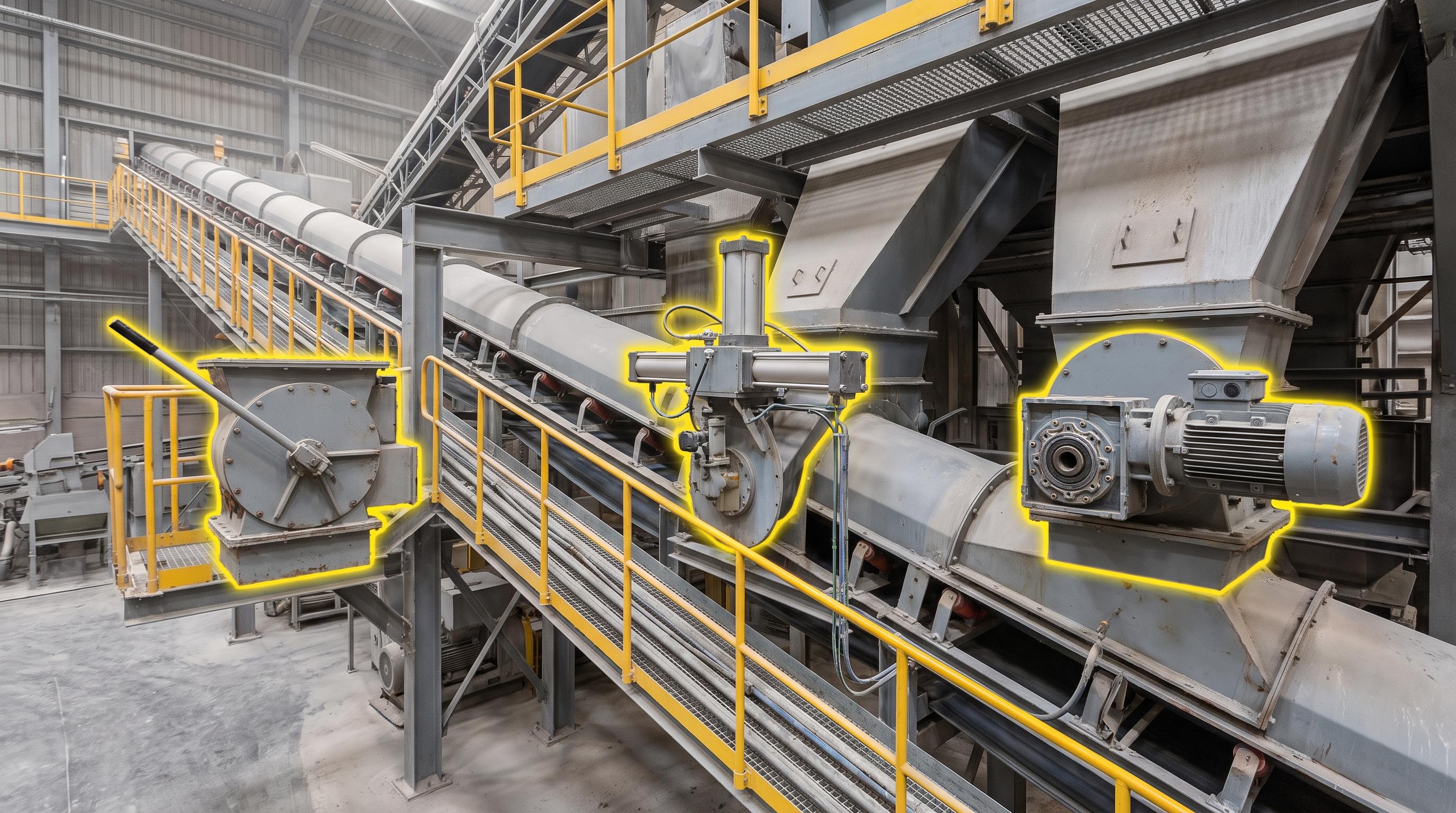
Manual diverters are best for infrequent, low-risk changes. Pneumatic diverters offer lightning-fast, high-cycle binary switching but require a clean air supply. Motorized diverters provide high-torque, precise modulating control for high-tonnage or heavy-column lines where sudden slamming forces could damage structural steel.
Bulk material routing sounds simple, but it often is not. Dry solids may need to move from one source to several destinations, such as silos, bins, or weigh hoppers. If you pick the wrong actuation method for your Diverter Valve line, you can end up with downtime, damaged actuators, and extra operator checks.
Many plants choose a valve on price alone. That decision often creates bigger problems later. This guide compares manual, pneumatic, and motorized options so you can match the valve to the job without overspending.
Side-by-Side Comparison
Operational Factor | Manual Diverters | Pneumatic Diverters | Motorized (Electric) Diverters |
Actuation Speed | Slow (Depends on operator) | Ultra-Fast (1–3 Seconds) | Modest (10–30 Seconds) |
System Automation | None (Local manual only) | Excellent (PLC Binary I/O) | Advanced (PLC Modulating/Analog) |
Torque/Force Output | Low (Human limited) | Moderate (Air-pressure limited) | Very High (Gearbox mechanical advantage) |
Utility Reliance | None | Clean Compressed Air (6 to 8 bar) | Stable Electrical Power |
Maintenance Profile | Low (Visual checks only) | Moderate (Seal swaps, air leaks) | Low-Moderate (Gearbox oil checks) |
The Direct Mechanical Breakdown
Every actuation method has a specific environment where it shines and places where it will absolutely fail.
Routing Shift Frequency | High Speed & High Volume? | Pneumatic |
Routing Shift Frequency | High Tonnage / High Load? | Motorized |
Routing Shift Frequency | Low Risk / Rare Changes? | Manual |
If you are deciding between manual, pneumatic, and motorized diverters, the next step is to match the actuator to your routing frequency, material load, and available plant utilities. The spec sheet gives you the practical design details needed to compare options against your process conditions before you finalize the selection.
1. Manual Diverter Valves: The Zero-Utility Standby
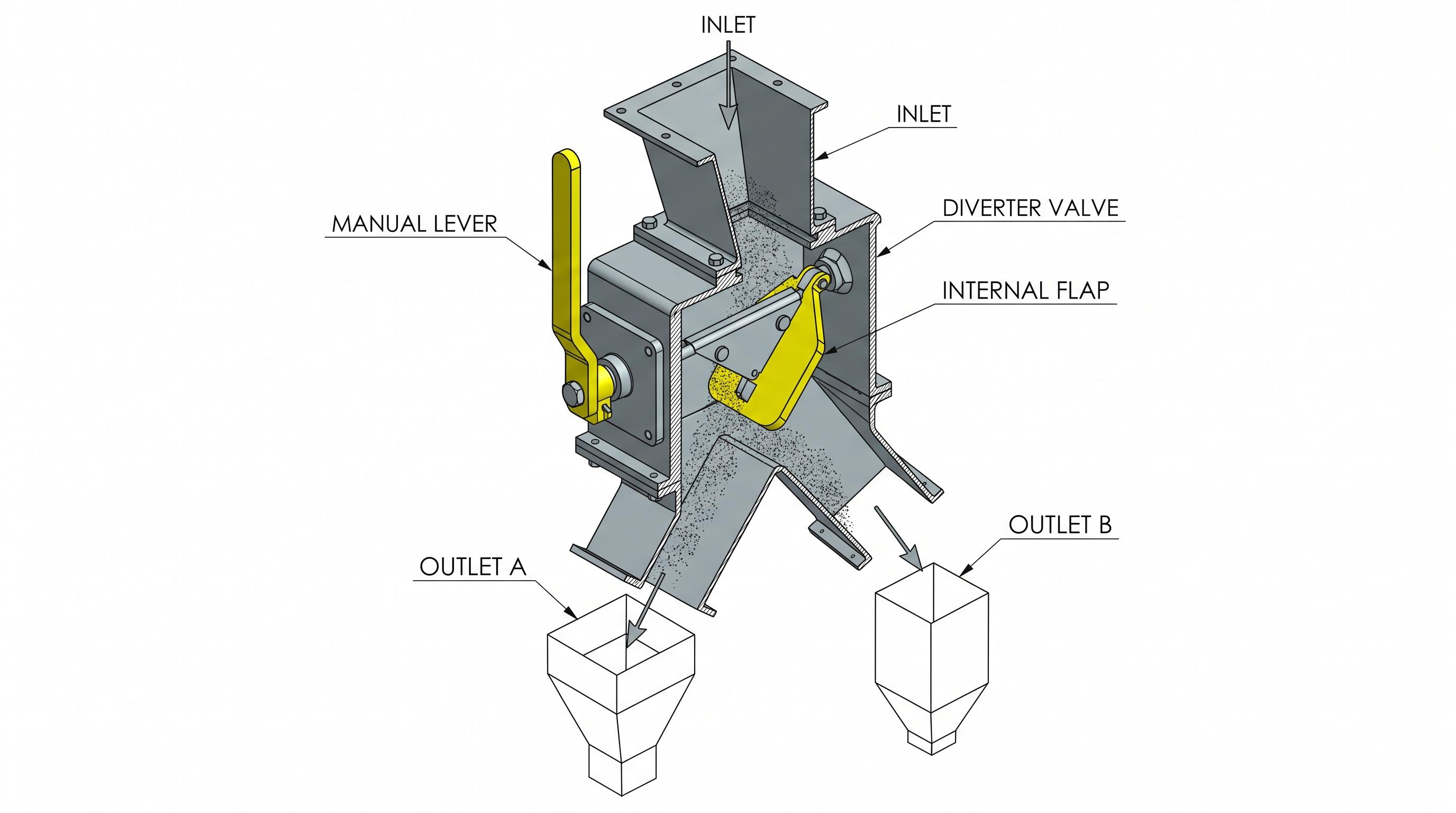
Manual diverters use a mechanical hand lever or a chain wheel assembly to physically swing the internal flap or gate blade.
Best Suited For: Low-frequency routing changes, such as switching a discharge path once or twice a week, and non-hazardous materials.
The Advantage: No electrical or pneumatic utility is needed. These valves are low-cost and reliable because there are no electronics to fail and no air lines to freeze.
The Reality Check: Manual valves do not tie into a plant PLC. They depend on operators to switch the line at the right time, which raises the risk of error and cross-contamination.
2. Pneumatic Diverter Valves: The High-Speed Workhorses
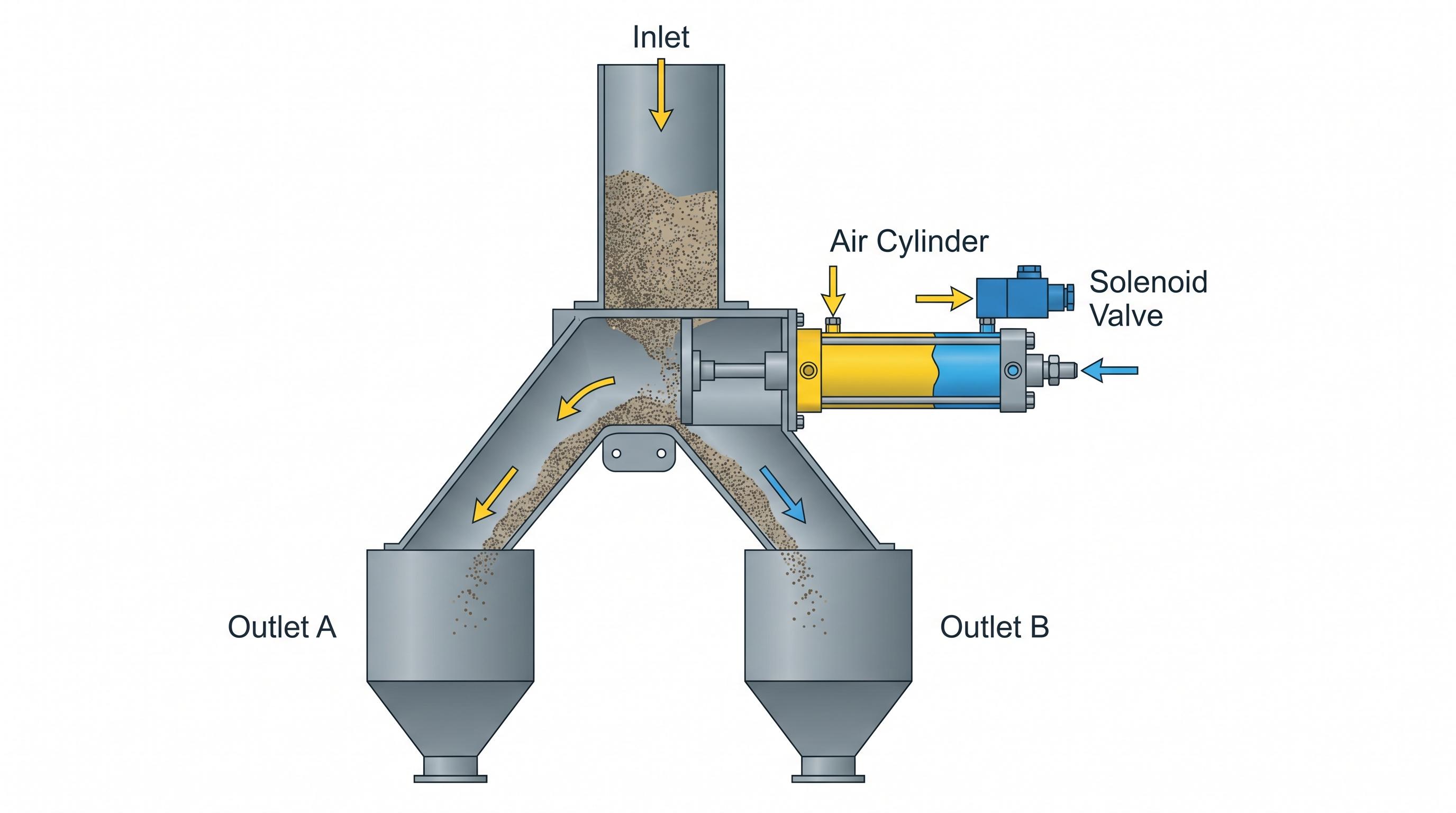
Paired with a double-acting air cylinder and a solenoid valve, pneumatic diverters use compressed air to snap the routing blade between ports in a matter of seconds.
Best Suited For: High-cycle automation, fast batching, and pneumatic conveying lines.
The Advantage: Pneumatic diverters switch very fast. With an air accumulator, they can also return to a safe position if plant power drops.
The Reality Check: They move with a hard slam. Over many cycles, that shock can loosen supports and wear seals faster. They also need clean, dry, lubricated instrument air, which adds cost and can be a problem in freezing conditions.
Why this matters on operating cost: a U.S. Department of Energy survey found that a typical industrial facility uses about 10% of its electricity to generate compressed air, and DOE leak guidance says compressed-air leaks often waste 20% to 30% of a compressor’s output.
Practitioner note: On retrofit batching lines, we often find the pneumatic actuator is not the root issue. The bigger problem is unstable plant air. When pressure drops during peak demand, the blade may not seat fully, which leads to carryover, false position feedback, and operator resets at the valve.
3. Motorized (Electric) Diverter Valves: Heavy-Torque Precision
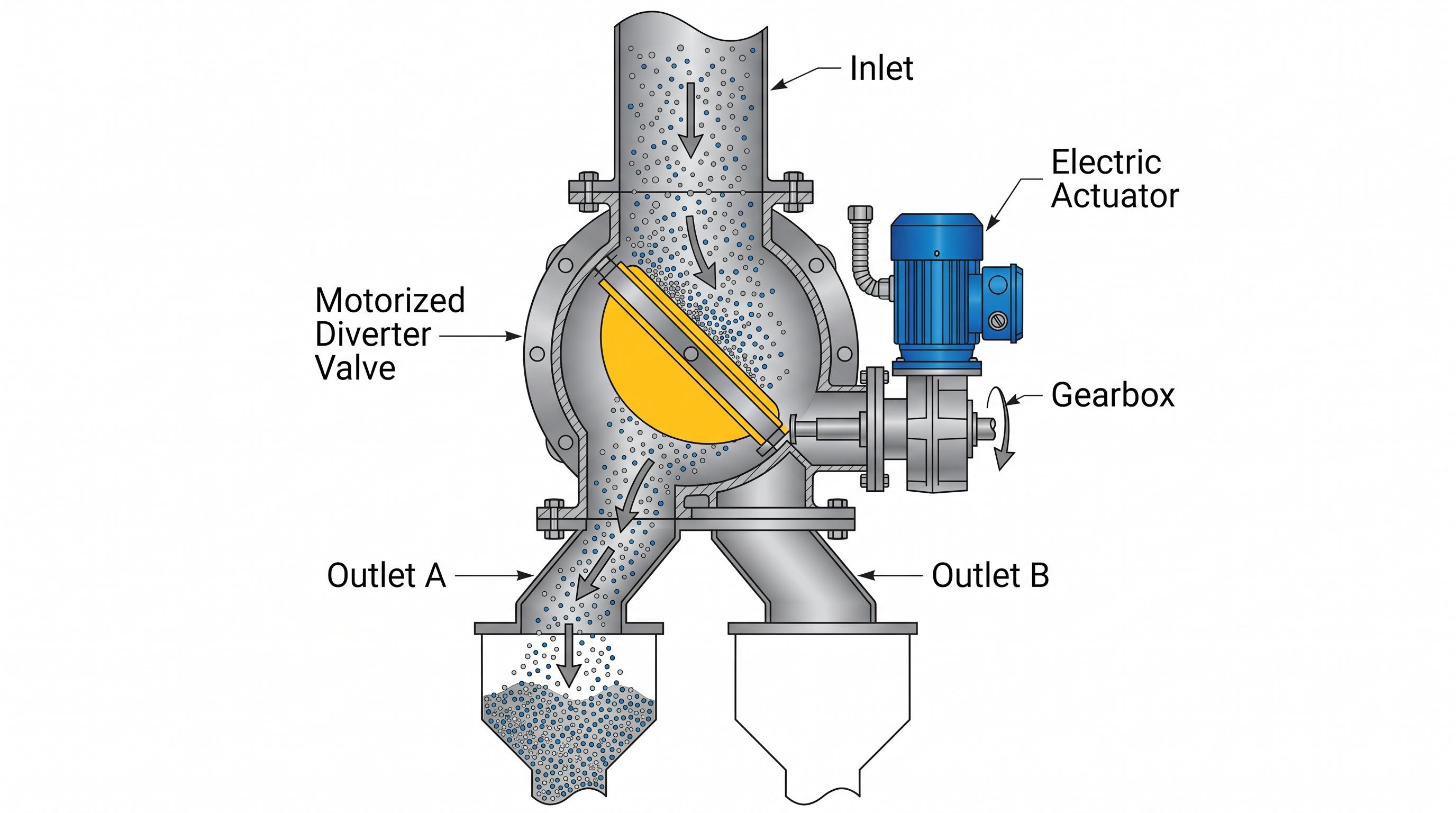
Driven by an industrial electric motor coupled with a high-ratio gearbox, motorized diverters smoothly rotate the internal gate or plug from one line to the next.
Best Suited For: High-tonnage gravity lines, large particles such as clinker or aggregate, and applications that need mid-travel positioning.
The Advantage: Electric actuators deliver high torque. They can move the blade through a heavy material column and do it with a smooth motion instead of a hard slam.
The Reality Check: They are slower than pneumatic units. A full stroke may take 10 to 30 seconds, and the upfront cost is usually higher.
Engineering Spec Check: Matching the Valve to the Material
Before you finalize your layout design, keep these material characteristics and global regulatory standards in mind:
Processing Fine Powders
Fine powders such as cement and fly ash need tighter sealing. A fast pneumatic switch can trap air inside the valve body and push dust out of the housing. Use adjustable perimeter packing seals to limit leakage. In gravity or low-pressure service, these powders can also drift through the line. In those cases, pairing the route with a dedicated Airslide Assembly helps keep the material stable and contained. For guarding and isolation around moving blades, see the ANSI/ASME B20.1 Safety Standard for Conveyors and Related Equipment.
Handling Highly Abrasive Bulk Profiles
Abrasive aggregates and raw minerals wear a valve quickly in gravity lines. The moving stream acts like a blast of grit inside the housing. Specify field-replaceable hardened liners in the high-wear zone. If you are automating these heavy blades, make sure the actuator also meets the core design requirements in the European Machinery Directive 2006/42/EC.
Deployment detail: In high-wear clinker and limestone lines, we usually specify bolt-in liners and an inspection access point on the impact side of the housing. That makes maintenance faster because crews can change wear parts without removing the full diverter body from the line.
Actuator jams or material leakage slowing your operation? Get expert guidance to optimize your valve selection and improve system reliability.
From the Field: We once worked with a coal-prep facility in a cold region. Each winter, its pneumatic diverters failed again and again. The valves stalled halfway through the stroke, which sent coal into both routing legs and shut down the main intake line.
The valve was not the real problem. Moisture in the plant’s compressed-air lines froze inside the solenoid ports. That stopped the cylinders mid-stroke. The site also could not justify heat tracing across hundreds of meters of overhead pipe.
The fix was simple in principle. We replaced the pneumatic cylinders with high-torque motorized electric actuators that had built-in strip heaters. That removed the plant’s dependence on air lines in winter and stopped the seasonal routing jams.
Final Takeaway
Do not let a generic catalog decide your routing setup. If your layout only needs rare changes during cleanout, a manual valve is usually enough. If you need fast automated batching, pneumatic actuation makes sense. If you handle heavy tonnage, high static head, or freezing conditions, a motorized setup is often the safer long-term choice. Pair it with robust Butterfly and Knife Gate Valves to protect uptime across the full process loop.
Good material flow control protects your Belt Conveyors and downstream equipment from early wear. Explore our full Diverter Valve range to build a routing layout that is more reliable and easier to maintain.
Frequently Asked Questions (FAQ)
No standard pneumatic diverter valves are designed for end-to-end travel, not stable mid-stroke holding. You can arrest a cylinder with specialized three-position solenoids, but holding a repeatable mid-position under a shifting material load is difficult. If you need true variable or multi-port routing, a motorized electric valve is the better fit.
A wye diverter uses a pivoting plate to switch between two discharge paths, while a plug diverter uses a rotating sealed tunnel to reroute material. Wye designs fit gravity flow or low-pressure dilute-phase lines. Plug designs are better for dense-phase pneumatic conveying where a tighter pressure seal is critical.
Protect it with an actuator that has adjustable internal torque switches. If the blade hits tramp metal or a hard material wedge, the switch cuts power before the motor overheats or the gearbox strips. That gives you fault protection without sacrificing torque during normal operation.
For fine, aerated powders like cement, use a tightly sealed routing setup rather than a standard diverter alone. In gravity or low-pressure service, pairing the line with an Airslide. Assembly and a modulating Flow Control Valve helps contain dust, maintain sealing, and keep throughput stable.
In tight vertical spaces, route horizontally with a compact Screw Conveyor line or use specialized dampers for air-suspended particulates. That avoids forcing a tall wye diverter into a layout with limited headroom while still giving you controlled discharge points.