
Conveyor Design
Return Idler Spacing Calculation: A Design Guide for Conveyor Engineers

Vijay Baid
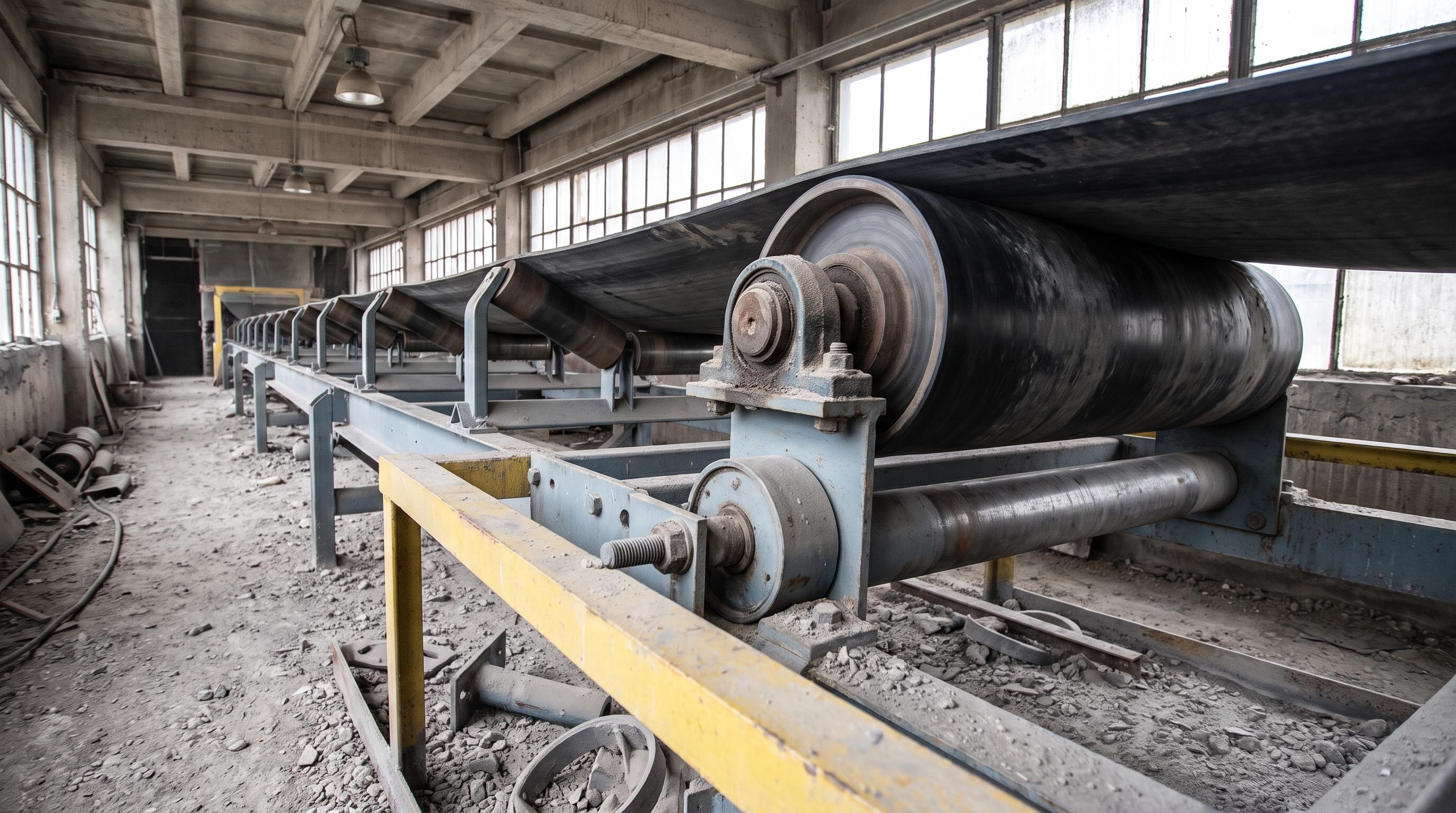
Return idler spacing is governed by belt sag. The working formula is S = 5WL²/8T, and the usual limit is a sag of 2 to 3 percent of the spacing. For most belts this puts return idlers around 3000 mm apart. Tighten the spacing near pulleys, curves, and in windy sections, where tension drops and sag rises.
Return idler spacing is the distance between the idlers that support the empty belt on its way back to the tail. Set it right and the belt runs quiet and tracks true. Set it too wide and the belt sags, flaps, and wears early.
The spacing is not a rule of thumb. It comes from one calculation: how much the belt is allowed to sag between two idlers. For most conveyors the answer lands between 2500 mm and 3000 mm, but the number should always be checked against the belt tension and the duty.
What is return idler spacing?
It is the centre-to-centre distance between idlers on the return strand of the belt.
The return strand is the underside of the belt, running empty from the head pulley back to the tail. It carries only the weight of the belt itself, plus any material that clings to the belt as carryback. Because it carries no load, the return side needs fewer idlers than the carrying side, spaced further apart.
Too wide: the belt sags between idlers, which causes flap, mistracking, and faster cover wear.
Too tight: you pay for idlers, frames, and bearings you did not need, and add rolling resistance the drive has to overcome.
Why return spacing is wider than the carrying side
Because the return belt has almost nothing to hold up.
On the carrying side, each idler supports the belt plus the full material load, so the idlers sit close together, often 1000 to 1500 mm apart. Sag there also has to stay tight, because a sagging loaded belt spills material at every idler.
The return side is a different problem. There is no material load and no spillage to worry about. The only thing sagging the belt is its own weight. So the spacing is driven purely by the belt mass and the return tension, and it opens up to around 3000 mm on most conveyors.
That single difference, load versus no load, is why you never carry the carrying-side spacing straight across to the return without recalculating. It is also why the carrying, return, and impact idlers on one conveyor are spaced and built differently, even where they look alike on the drawing.
How to calculate return idler spacing
The design check is based on belt sag between two idlers. The belt hangs in a shallow catenary, and the sag is:
S = 5 W L2 /(8 T)
Where:
S = belt sag between idlers (m)
W = belt weight plus carryback per meter (N/m)
L = idler spacing (m)
T = belt tension at that point (N)
Keep the units consistent. If weight is in Newtons per meter and tension in Newtons, spacing must be in meters.
In design you rarely solve for sag. You solve for the spacing that keeps sag within a limit. Rearrange the formula around the sag ratio, S divided by L:
Lmax = 8 T r / (5W)
Here r is the allowable sag ratio, for example 0.03 for a 3 percent limit. This gives you the widest spacing the belt tension will allow. It is the number to design to, then round down to a practical idler pitch.
How much belt sag is acceptable?
The common design limit is 2 to 3 percent of the spacing.
Sag is always expressed as a ratio of the idler spacing, not as a fixed distance. The tighter the ratio, the closer the idlers and the steadier the belt. Standard practice sits in a narrow band:
2 percent at minimum tension, and for well-troughed carrying idlers, is the conservative choice
3 percent is widely used on return runs and for lower troughing angles
4.5 percent is the limit for a loaded belt standing still, not a running design target
Use 3 percent as the usual working figure for return idlers.
Drop to 2 to 2.5 percent for high belt speeds.
Use the tighter limit for long spans.
Use the tighter limit for exposed outdoor conveyors where wind can unsettle the belt.
Typical return idler spacing by belt width
Field practice and standard tables place return idler spacing in these ranges. Use them as a starting point, then confirm with the sag calculation.
Belt width | Typical return spacing | Notes |
|---|---|---|
500 to 800 mm | 2500 to 3000 mm | Flat return usually enough |
1000 to 1400 mm | 2800 to 3000 mm | Check tracking and carryback |
1600 mm and above | 3000 to 3200 mm | V-return often preferred |
Notice how little the spacing changes with belt width. That is because return spacing follows belt mass and tension, which do not climb as steeply as the material load on the carrying side. A wider belt gets a wider roll, not a very different pitch.
Worked example: a 1200 mm belt conveyor
Take a 1200 mm belt with a belt weight of 16.5 kg/m, carryback of 3 kg/m, a return tension of 12,000 N, and a 3 percent sag limit.
Step 1. Total mass per metre: 16.5 + 3 = 19.5 kg/m
Step 2. Convert to force: 19.5 × 9.81 = 191.3 N/m
Step 3. Find the maximum spacing at 3 percent sag (r = 0.03): Lmax = 8 × 12,000 × 0.03 / (5 × 191.3) = 3011 mm
Step 4. Round to a practical pitch: 3000 mm
So 3000 mm spacing gives just under 3 percent sag for this belt. A practical design would still tighten the pitch near the pulleys and any transition, where tension is lower. For most of the run, a working range of 2800 to 3000 mm is a sound engineering choice.
The idler load rating has to suit the belt and roll size too. Our conveyor idlers are built to matched load ratings, and the spec sheet lists the ratings and roll dimensions to check a spacing schedule against.
Types of return idlers
The calculation sets the spacing. The idler type is a separate choice, driven mostly by belt width and carryback, and it sits inside the wider idler selection for the conveyor.
Type | Description | Best for |
|---|---|---|
Flat return | A single long roll across the belt width | Small and moderate belts, clean material, lowest cost |
Two-roll V-return | Two rolls tilted at 5, 10, or 15 degrees, rigid or garland | Wide belts and outdoor lines needing better tracking |
Self-cleaning disc | Roll fitted with rubber or urethane discs | Sticky material and high carryback, where a plain roll would cake |
Troughed return | Return rolls set at 0, 10, or 15 degrees | Extra belt support and training on wider conveyors |
The self-cleaning disc return is the one plants forget. On sticky material, carryback builds on a plain return roll, throws it out of balance, and pushes the belt off track. The discs give the material nowhere to pack, so the roll stays clean and true. If your belt carries damp fines or clinker, this is often the return idler worth specifying.
Where to reduce return idler spacing
Even when the calculation supports 3000 mm, good design tightens the spacing in a few places:
Near tail, drive, and take-up pulleys. Tension is lower here, so the same belt sags more. Close the pitch up.
On curves and transitions. Belt geometry and tension change, so the standard spacing no longer holds.
In outdoor or windy sections. Wind lifts and flutters a slack belt. Tighter idlers steady it.
On high-speed conveyors. Dynamic effects grow with speed, so design more conservatively.
Where carryback is high. More clinging material means more weight and more sag. Tighten the pitch or improve belt cleaning.
The practical output is not one number. It is a spacing schedule that opens the idlers up along the free-running span and closes them near the pulleys and transitions.
Return idler spacing and belt tracking
Spacing and tracking are linked. A return belt that sags too much between idlers wanders, and once it wanders it wears its edges and spills carryback along the structure.
Two moves help. Choosing a V-return or troughed return gives the belt a shallow trough that centers it. And adding self-aligning, or training, idlers on the return run corrects drift before it becomes damage. Training idlers are usually spaced 30 to 45 meters apart, with at least one on any conveyor long enough to wander.
Tracking problems are rarely solved by tension alone. Spacing, idler type, and training work together.
Standards and references
Return idler spacing is covered by the main belt conveyor standards, and it is worth designing to whichever governs your project:
IS 8598 sets the specification for idlers and idler sets used on belt conveyors in India.
CEMA, in Belt Conveyors for Bulk Materials, gives the sag limits and the minimum tension needed to hold them, and is the reference most widely used internationally.
ISO 1537 and DIN 15207 cover troughed belt conveyor idlers for projects specified to international standards.
The engineering is the same across all of them: limit the sag, size the idler to the load, and tighten the pitch where tension drops.
Design checklist
Confirm belt width, belt mass, and return tension
Estimate carryback realistically, not optimistically
Solve for maximum spacing at your sag limit, then round to a practical pitch
Choose flat, V-return, troughed, or self-cleaning based on width and carryback
Tighten spacing near pulleys, curves, transitions, and in wind
Add training idlers on long return runs
Issue a spacing schedule, not a single value for the whole conveyor
Common mistakes to avoid
The return run is the part of a conveyor that gets designed once and then left alone for years. That is why these mistakes tend to survive quietly until the belt starts mistracking or spilling carryback along the structure. The ones that come up most often on the return runs we are asked to look at:
Carrying the carrying-side spacing straight across to the return without recalculating
Ignoring carryback, which adds weight and sag on the return
Using the maximum spacing over the entire length, including the low-tension pulley zones
Overlooking wind, speed, and transition effects
Specifying a plain flat return on sticky material instead of a self-cleaning disc
Designing for lowest first cost instead of belt life and reliability
Getting these right is the difference between a return run that is quiet and forgotten and one that mistracks and spills for years. Want a second set of eyes on a layout? Our engineers can size the idler set and work out a spacing schedule for your belt, tension, and material.
Key takeaways
Return idler spacing is set by belt sag, using S = 5WL²/8T, not by a fixed rule.
Solve for the widest spacing at a 2 to 3 percent sag limit with Lmax = 8Tr/5W, then round to a practical pitch.
For most belts this lands around 3000 mm, because the return carries only belt weight, not material.
Match the idler type to the duty: flat for clean material, V-return or troughed for wide and outdoor belts, self-cleaning discs for carryback.
Tighten the pitch near pulleys, curves, and in wind, and issue a spacing schedule rather than one number.
Frequently Asked Questions
A typical starting range is 2500 mm to 3000 mm, and 3000 mm is common. The exact value should be confirmed with the sag calculation using the belt weight, carryback, and return tension. Spacing is then tightened near pulleys and transitions where tension is lower.
Base it on belt sag between idlers. The sag is S = 5WL²/8T, where W is belt weight plus carryback per metre, L is spacing, and T is belt tension. In design, solve for the maximum spacing at your sag limit with Lmax= 8Tr/5W, where r is the allowable sag ratio, then round down to a practical pitch.
Two to three percent of the idler spacing is the usual band. Three percent is common on return runs, while 2 to 2.5 percent suits high speeds, long spans, and exposed outdoor conveyors. A loaded belt standing still may reach 4.5 percent, but that is a limit, not a running design target.
Because the return belt carries only its own weight, with no material load and no spillage to control. The carrying side supports the full material load and must limit sag to prevent spillage, so its idlers sit closer together, often 1000 to 1500 mm. The return side opens up to around 3000 mm.
Tighten the spacing near tail, drive, and take-up pulleys where tension is lower, on curves and transitions, in windy outdoor sections, on high-speed conveyors, and wherever carryback is high. These are the places where sag rises above the calculated value for the free-running span.
A self-cleaning return idler fitted with rubber or urethane discs. Sticky material and carryback build up on a plain flat roll, unbalance it, and push the belt off track. The discs give the material nowhere to pack, keeping the roll clean and the belt tracking true.